


Integrated Local Delivery, England
.svg)
This case innovation has been analysed using the Transformative Intervention Mixes (TIMs) framework. The framework maps the regulatory, economic, social‑behavioural, technological and material interventions at play, clarifying how these elements interact and what this configuration suggests about the innovation’s capacity to support transformative change.
The case analysis draws primarily on evidence synthesised from:
Black et al. (2025), Phelps et al. (2017) and Countryside and Community Research Institute website (n.d.)
Overview
Water with Integrated Local Delivery (WILD) - England
Green Belt Berlin
Catchment-scale water quality and biodiversity restoration; agri-environment practice change; collaborative catchment governance
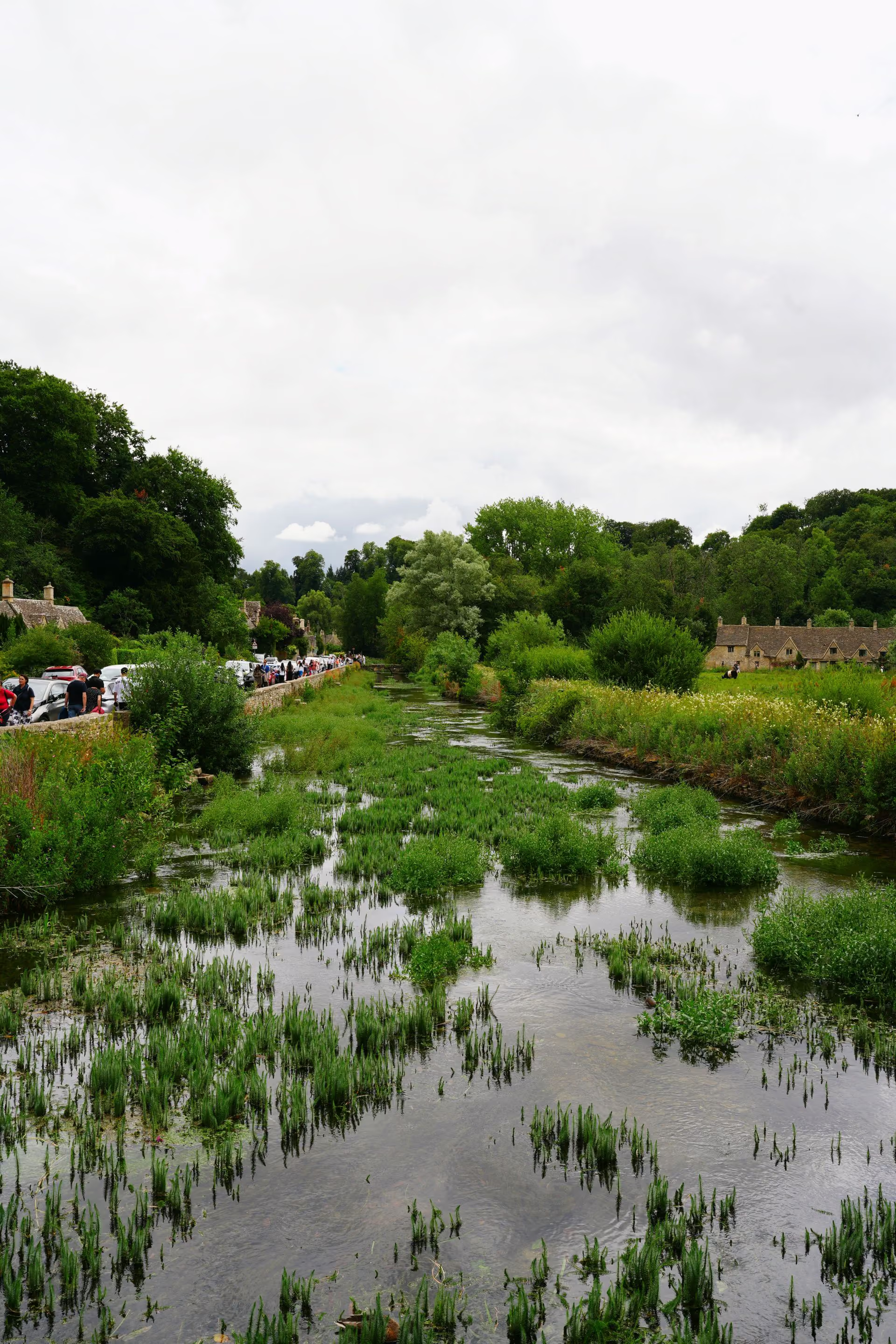
WILD applied the Integrated Local Delivery (ILD) approach within the Upper Thames catchment (Cotswolds, South West England), triggered by the requirement to improve the ecological status of watercourses under the EU Water Framework Directive (WFD). The project used a multi-stakeholder, bottom-up partnership model to plan and implement direct actions and embed local delivery for long-term water quality and biodiversity outcomes.
[Note: The WFD was transposed into UK law pre-Brexit and remains in effect post-Brexit, still guiding water quality and management standards.]
Landscape/ catchment scale of approximately 25,000–26,000 ha; Phase 1 ran April 2013–March 2016 (with a subsequent stage 2016–2018 noted), involving extensive advisory visits and engagement with farms and local communities.
Practical: direct actions and practice changes (e.g., reducing chemical use, protecting riverbanks, clearing waterways) informed by catchment walkovers and advisory visits.
Political: partnership governance spanning agencies, NGOs and community actors to deliver Water Framework Directive objectives and integrate partner strategic programmes.
Personal: empowerment of ‘farmer guardians’ and iterative learning emphasising trust, motivation and stakeholders feeling listened to.
High: source material presents ILD as transferable, with outputs such as a Community Water Guide and identified enabling conditions (facilitation capacity, continuity and communication) for replication.
TIMs Summary
WILD is strongly evidenced in the source material for voluntary-advisory-educational, infrastructure (soft) and knowledge tools, delivered through extensive advisory visits, iterative learning, and partnership coordination to implement catchment restoration actions. Regulatory influence is present as an external driver through the EU Water Framework Directive (WFD) and associated ‘Good Ecological Status’ objectives, but the documented intervention relies primarily on voluntary engagement rather than coercive enforcement.
Social-norm and personal-capacity mechanisms are evidenced through the appointment of farmer guardians as peer-facing contacts and through emphasis on trust, shared responsibility and inclusive communication. Market-based mechanisms are present mainly as funding arrangements rather than price instruments, while choice architecture and emotional appeal are weakly evidenced or absent in the source material.
This configuration implies a relational–institutional transformative pathway in which facilitation and multi-actor integration enable practice change at landscape scale. Sustained outcomes depend on well-trained facilitation and continuity to maintain engagement over time.
Implications for Intervention Mix Design
The documented mix suggests that voluntary advisory and coordination tools carry much of the intervention load, which can leave durability vulnerable to funding cycles and participant fatigue. To enhance transformative scope, additional alignment would be required with financial mechanisms that secure longer-term delivery capacity and with clearer institutional mandates for responsibilities across partners. Where behavioural uptake is uneven, complementary choice-architecture elements in engagement and advisory workflows could help prioritise actions and reduce transaction costs.
TIMs Matrix
| Tool Category | Examples | How it ENABLES (mechanisms) | How it HINDERS (barriers) | Opportunities to strengthen | Risks / caveats | Additional suggestions and resources |
|---|---|---|---|---|---|---|
| Regulatory | EU Water Framework Directive objective to achieve ‘Good Ecological Status’ by set timelines; linkage to Upper Thames Catchment Management Plan objectives. | The Water Framework Directive provides an external legal performance driver and common objective that legitimises action and supports coordination across institutions. | Complexity of policy layering and time-bound targets can create pressure that is difficult to operationalise through voluntary mechanisms alone. | If regulatory objectives are not matched with delivery capacity, projects may focus on short-term compliance rather than sustained practice change. | Catchment-based approaches and statutory water management planning instruments aligned with EU Water Framework Directive objectives. | |
| Financial / Market-Based | Project funding by the Environment Agency with additional in-kind contributions and grant funders; advisory delivery at scale across farms. | Funding underwrites facilitation and advisory capacity needed to coordinate actions across many land managers and communities. | Dependence on time-limited project funding can constrain continuity and long-term maintenance of practices. | Establish longer-term funding mechanisms to retain facilitation and maintain engagement beyond project phases. | Short funding cycles risk loss of institutional memory and reduced confidence among participants. | Agri-environment schemes and water company programmes that support practice change. Additional complementary instruments could include results based agri environment payments, targeted capital grants for water quality infrastructure, landscape-scale stewardship schemes, and co funded advisory services that secure long term facilitation capacity. |
| Information / Education | Catchment walkovers and advisory visits; Community Water Guide developed with community input; newsletters and stakeholder surveys reported in the phase summary. | WILD builds shared understanding of local water issues and practical options, supports behaviour change, and codifies learning for wider application. | Information provision can be resource-intensive and may not persist without ongoing facilitation. | Explicit: stakeholder communication and ensuring people feel listened to are identified as essential for trust and motivation. | If communication is inconsistent, trust may erode and participation may decline. | Local demonstration networks and peer-to-peer learning structures. |
| Choice Architecture | ||||||
| Social Norms | Appointment of farmer guardians as key contacts between farmers and institutions; emphasis on collective responsibility for water quality. | Peer-facing roles and collective framing can normalise stewardship practices and sustain engagement beyond one-off advisory interactions. | Reasonably implied: strengthen guardian networks and peer exchange to maintain momentum and reduce reliance on central facilitation. | Over-reliance on a small number of guardians may create vulnerability if individuals disengage. | Catchment partnerships and local stewardship groups that broaden participation. | |
| Emotional Appeal | ||||||
| Technology | Use of waterbody templates, water flow maps and parish datasets (referenced as appendices in the phase summary). | Standardised templates and spatial datasets support consistent planning, prioritisation and reporting across water bodies and parishes. | Digital dashboards and open data platforms for catchment reporting. | |||
| Infrastructure (Hard/Soft) | Multi-organisation partnership structure led by FWAG with key delivery partners; ILD framework with defined steps and action-research learning loop. | Governance infrastructure creates coordination capacity across institutional levels and disciplines, enabling integrated planning and implementation at landscape scale. | Coordination demands can be high, requiring sustained facilitation capacity and continuity. | Well-trained facilitators and continuity over the long term. | If facilitation capacity is lost, collaboration may fragment and practice changes may not be sustained. | Formal memoranda of understanding across partners to stabilise roles and responsibilities. |
| Biophysical Resources | Direct actions to protect riverbanks from livestock damage; clearing waterways; actions to enhance water quality and biodiversity across water bodies. | WILD improves ecological condition of watercourses and associated habitats through on-the-ground management interventions. | If interventions are not maintained, ecological gains may be transient. | Natural flood management and habitat restoration programmes linked to catchment objectives. | ||
| Knowledge | Iterative learning loop of reflection and evolution; action research framing; evidence on behaviour change and project outcomes (compiled in phase summary). | WILD supports adaptive management and learning-by-doing, strengthening the fit between actions, stakeholder capacities and ecological outcomes. | Learning processes require time and facilitation; they may be constrained by project timelines. | Reflective practice and adaptation are presented in the source material as integral to strengthening socio-ecological systems. | If learning is not institutionalised, insights may not transfer to subsequent phases or other catchments. | Independent evaluation and synthesis platforms for cross-catchment learning. |
| Other |
Note: Blank cells reflect that the documentary evidence available for this case did not contain sufficiently explicit information to address these dimensions. This absence should not be interpreted as implying that such mechanisms were irrelevant or ineffective, but simply that they were not documented within the scope of the source materials.
References
Black, J. E., Short, C., & Phelps, J. (2025). Water with Integrated Local Delivery (WILD) for transformative change in socio-ecological management. In M. Nishi et al. (Eds.), Fostering transformative change for sustainability in the context of socio-ecological production landscapes and seascapes (SEPLS). https://doi.org/10.1007/978-981-33-6761-6_9
Phelps, J., Short, C., Brown, P., & Richards, H. (2017). Overview of the Water and Integrated Local Delivery (WILD) Project Phase 1: 1st April 2013 - 31st March 2016. Report to Environment Agency, Countryside and Community Research Centre (CCRI), University of Gloucestershire. https://fwagsw.org.uk/wp-content/uploads/2025/08/Overview_of_the_Water_and_Integrated_Local_Delivery_Final_Summary_012017-002.pdf
Countryside and Community Research Institute. (n.d.). Water with Integrated Local Delivery (WILD). Retrieved 27 February 2026. https://ccri.ac.uk/research-projects/04/2013/wild/