


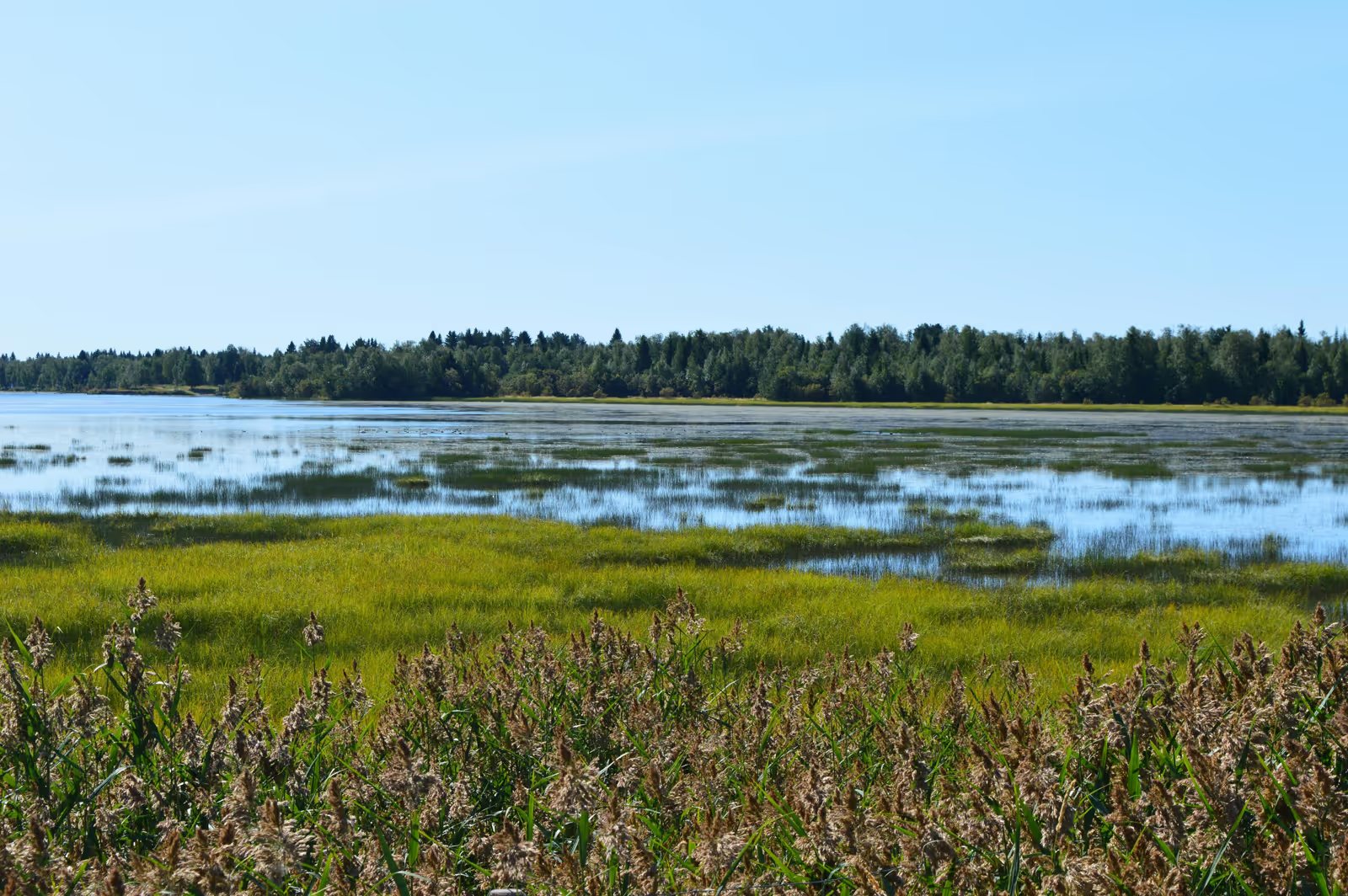
Kristianstads Vattenrike (KV) wetland landscape, Sweden
.svg)
This case innovation has been analysed using the Transformative Intervention Mixes (TIMs) framework. The framework maps the regulatory, economic, social‑behavioural, technological and material interventions at play, clarifying how these elements interact and what this configuration suggests about the innovation’s capacity to support transformative change.
The case analysis draws primarily on evidence synthesised from:
Hahn et al. (2006)
Overview
Adaptive Co-management of a Wetland Landscape
Kristianstads Vattenrike (KV) wetland landscape, Sweden
Wetland and catchment ecosystem management; multi-actor governance; education and recreation linked to conservation
Wetland landscape with high ecological and cultural-historical value under changing conditions; establishment of a small municipal organisation (EKV) acting as a bridging organisation to coordinate projects and networks across levels.
Lower Helgeå River catchment within the Municipality of Kristianstad; Ramsar core area and UNESCO Man and the Biosphere Reserve designation; network engaging ~200 participants across ~20 projects.
Practical: ad hoc ecosystem management projects (e.g., flooded meadow restoration, inventories) coordinated through EKV with collaborative learning.
Political: creation of EKV as a municipal organisation navigating existing legal-political frameworks and coordinating cross-level actor networks.
Personal: trust-building and preference formation through arenas for collaboration and learning among diverse actors.
Potential is linked to the bridging-organisation model (flexible coordination, network mobilisation, and cross-level collaboration) and to sustained resourcing for convening and learning infrastructures; dependence on key individuals and external programmes is a documented constraint.
TIMs Summary
The case is strongly evidenced in the source material for soft-infrastructure and knowledge tools centred on EKV ((Ecomuseum Kristianstads Vattenrike,a small municipal organisation) as a bridging organisation that convenes networks, creates arenas for collaborative learning, and coordinates ad hoc ecosystem management projects. Financial mechanisms are present as blended resourcing and core municipal funding, but the organisation explicitly lacks regulatory authority and instead navigates existing legal-political frameworks. Information and education tools are materially expressed through the Nature School and outdoor museum infrastructure, which also supports learning and legitimacy. Technology is evidenced mainly through management equipment and visitor access infrastructure, rather than digital systems.
Overall, the configuration implies a relational and organisational transformative pathway, where practical wetland management and resilience are achieved via trust-building and cross-level coordination rather than enforceable rule change.
Implications for Intervention Mix Design
The source material suggests that where direct regulatory authority is limited, combining bridging-organisation infrastructure with sustained knowledge generation and flexible project mobilisation can still produce coordinated action. To enhance transformative scope elsewhere, additional alignment might be needed with explicit regulatory mandates or longer-term financing arrangements that stabilise convening and maintenance functions, neither of which is fully evidenced beyond the documented municipal budget and grant navigation.
TIMs Matrix
| Tool Category | Examples | How it ENABLES (mechanisms) | How it HINDERS (barriers) | Opportunities to strengthen | Risks / caveats | Additional suggestions and resources |
|---|---|---|---|---|---|---|
| Regulatory | Ecomuseum Kristianstads Vattenrike (EKV) explicitly has no legal authority to make or enforce rules; governance operates by navigating existing legal-political frameworks, including protected-area and designation contexts (e.g., Ramsar, MAB). | The initiative indirectly enables action by EKV working within existing regulations and helping actors align projects with institutional requirements. | Absence of rule-making authority limits direct capacity to mandate behaviours or enforce ecological protections. | Reliance on goodwill and alignment rather than enforceable authority can reduce durability under conflict or shifting political priorities. | Regulatory instruments that formally recognise and support the coordinating (and advising) role of bridging organisations in wetland governance. Long-term funding mechanisms for coordination functions. | |
| Financial / Market-Based | EKV attracts financial resources from various sources by presenting projects as ‘profitable’ in terms of nonmonetary goals; municipal funding of approximately 1.8 Million Swedish Kroner (MSEK) per year for core office costs. | The initiative mobilises and blends resources for concrete projects and enables rapid project formation as issues arise. | Dependence on external funding opportunities and programme cycles can constrain timing and continuity of projects. | Assisting actors to apply for investment grants is documented in the source material as a facilitation pathway for strengthening resourcing of practical interventions. | Framing projects as ‘win–win’ may underplay distributional conflicts and obscure trade-offs that later surface. | Dedicated long-term funds for maintenance of wetlands and learning infrastructures insulated from short-term programme cycles, e.g., Wetland Stewardship Fund – long‑term municipal–regional fund for wetland maintenance, visitor infrastructure and learning sites, reducing dependence on short project cycles. Bridging Organisation Coordination Grants – multi‑year operating grants for small municipal bridging organisations to fund coordination, facilitation and knowledge‑brokering. Ecosystem Stewardship Contracts – payments to landowners and user groups for sustained management of wetland habitats that deliver biodiversity and flood‑regulation outcomes. Co‑financed Adaptive Management Investment Grants – capital grants for shared management equipment and low‑impact access infrastructure, agreed through collaborative wetland governance processes. |
| Information / Education | Nature School and information secretary roles; outdoor museum sites with information and exhibitions used as experience-and-learning sites. | Educational components build awareness, capacity and shared understanding of wetland values, supporting broader legitimacy for management actions. | Education and visitor-oriented programmes may be vulnerable to budget cuts if framed as non-essential, reducing long-term support. | Formal integration of education outcomes into municipal sustainability and land-use strategies. | ||
| Choice Architecture | Creation of arenas for trust-building, knowledge generation and collaborative learning; flexible project organisation enabling ad hoc mobilisation rather than fixed committees. | The initiative structures participation pathways so actors can join issue-specific sub-networks when relevant, reducing transaction costs for engagement. | A fixed structure with regular meetings for all projects is described as administratively burdensome, which can deter participation if over-formalised. | Ad hoc mobilisation can privilege well-connected actors and make participation less predictable for marginal stakeholders. | Transparent participation protocols for project formation and stakeholder inclusion across subnetworks. | |
| Social Norms | Broad support and legitimacy for ecosystem management built among diverse actors; loose social network of local stewards and key persons across levels coordinated by EKV. | The initiative creates shared expectations that collaborative stewardship is the normal mode of managing the wetland landscape. | Norms may be strongly tied to the bridging organisation's credibility; reputational shocks can cascade through the network. | Distributed stewardship structures that reduce dependence on a single central node for normative alignment. | ||
| Emotional Appeal | ||||||
| Technology | Construction of a harvest machine for wetlands enabled by investment grants; trails and footbridges as part of the physical outdoor museum facilitating access to wetland sites. | The initiative enables practical management and public engagement by providing tools for wetland maintenance and access to learning sites. | Physical infrastructures were built through government programmes during recession, implying dependence on external programmes for capital investment. | Infrastructure can increase visitor pressure if not managed in line with ecological sensitivity of sites. | Monitoring technologies integrated into visitor infrastructure to manage impacts and support adaptive learning. | |
| Infrastructure (Hard/Soft) | EKV as a small, flexible municipal organisation; networked project structure engaging ~200 people across ~20 projects. | EKV provides convening, coordination and administrative capacity to mobilise diverse actors and sustain cross-level collaboration. | Dependence on a nucleus of reliable staff and borrowing competence from network actors can be fragile if key roles change. | Maintaining a core staff nucleus is explicitly framed as essential to organisational adaptability. | Institutional memory and coordination capacity may degrade if staffing is unstable or if the organisation loses municipal backing. | Formalised succession planning and role redundancy within bridging organisations. |
| Biophysical Resources | Protection and restoration of flooded meadows; coordination of nature conservation inventories and projects addressing habitats across the wetland landscape. | The initiative directly targets ecological condition and resilience by maintaining and restoring wetland habitats and associated biodiversity. | Project-by-project focus may miss cumulative impacts unless coordinated through landscape-scale monitoring and synthesis. | Landscape-scale ecological monitoring programmes linked to project prioritisation. | ||
| Knowledge | Knowledge generation and collaborative learning described as core functions of EKV; hiring external scientists for inventories and compiling biodiversity observation lists. | The initiative produces and circulates evidence to support adaptive responses to change and shared understanding among actors. | If knowledge remains fragmented across projects, it may not translate into coherent strategic direction. | Shared data platforms and synthesis routines that aggregate project learning for strategic decision-making. | ||
| Other | EKV explicitly characterised in the source material as a ‘bridging organisation’ creating arenas for trust-building, preference formation and conflict solving among actors. | Bridging organisations such as EKV combine network governance and organisational innovation to enhance social capacity for adaptive co-management. | Bridging organisations can become gatekeepers if accountability and transparency mechanisms are weak. | Independent evaluation and accountability mechanisms for bridging organisations' convening and coordination roles. |
Note: Blank cells reflect that the documentary evidence available for this case did not contain sufficiently explicit information to address these dimensions. This absence should not be interpreted as implying that such mechanisms were irrelevant or ineffective, but simply that they were not documented within the scope of the source materials.