


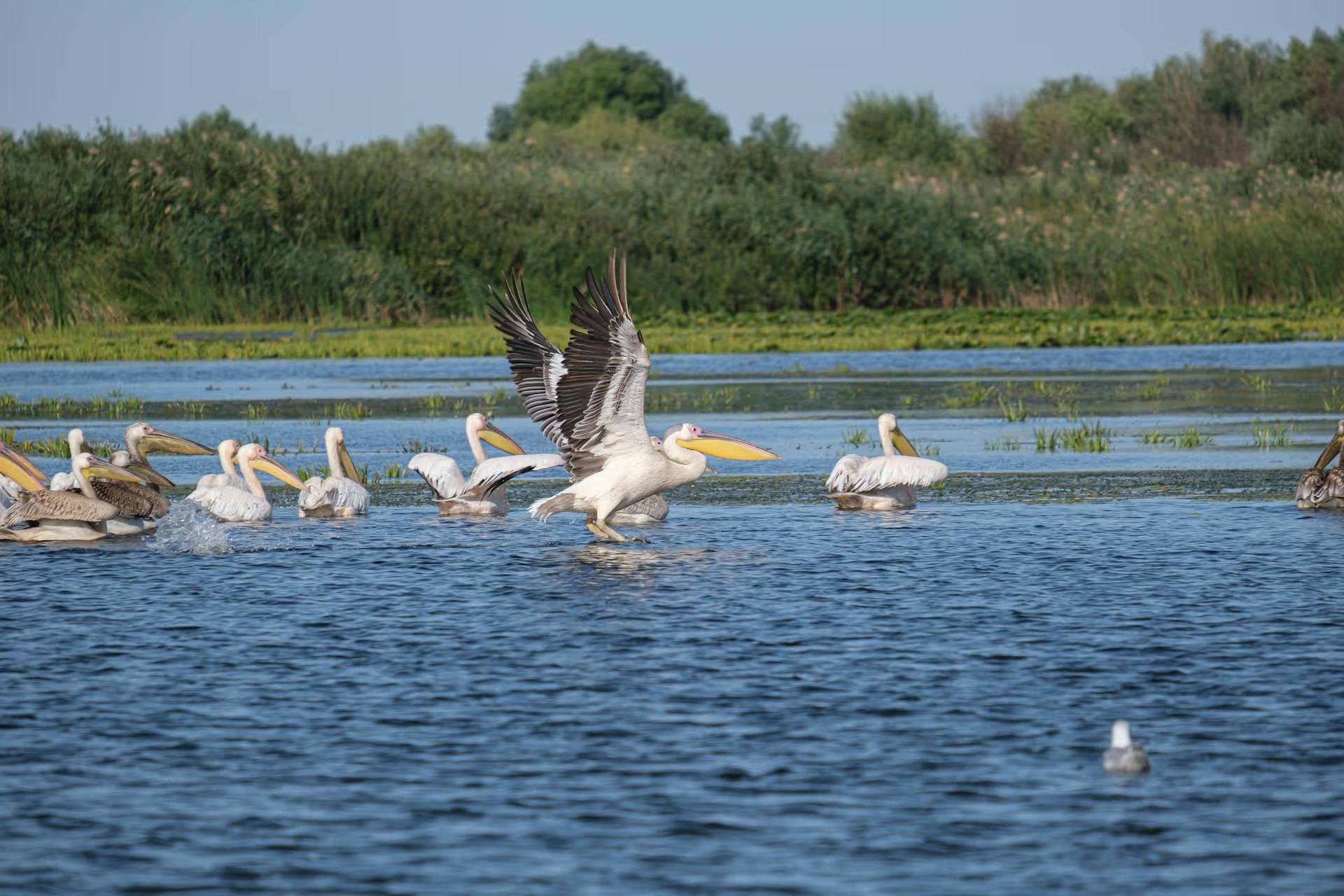
Reducing Water-Related Risks - Lower Danube, Romania
.svg)
This case innovation has been analysed using the Transformative Intervention Mixes (TIMs) framework. The framework maps the regulatory, economic, social‑behavioural, technological and material interventions at play, clarifying how these elements interact and what this configuration suggests about the innovation’s capacity to support transformative change.
The case analysis draws primarily on evidence synthesised from:
Balaican et al. (2024), Giordano et al. (2020), Perosa et al. (2021), Potočki et al. (2021) and Scrieciu et al. (2023)
Overview
Nature based solutions (NbS)
Reducing water-related risks in the lower Danube
Flood risk management, floodplain restoration, wetland conservation, and regional water governance
Lower Danube case focused on reducing flood and drought risks through nature-based solutions, especially wetland restoration, retention areas, river renaturation and reforestation, with a detailed focus on the Dabuleni–Potelu–Corabia enclosure in Romania.
Regional Lower Danube case with local design and modelling work centred on the Dabuleni–Potelu–Corabia enclosure.
Practical: reconnecting former floodplain areas, restoring wetland functions, and modelling retention scenarios to reduce flood peaks and drought pressures.
Political: aligning interventions with the Water Framework Directive and Flood Directive and using stakeholder engagement to connect local communities, river basin authorities and decision-makers.
Personal: stakeholder processes elicited local knowledge and values and explicitly addressed community risk awareness.
High, because the case combines biophysical restoration, participatory co-design and analytical assessment tools, but wider amplification depends on institutional cooperation, land access conditions, local acceptance and sustained implementation support.
TIMs Summary
The strongest evidence is for Biophysical Resources, Knowledge, Technology, Information / Education and Choice Architecture. Wetland restoration, retention areas, river renaturation and reforestation are central to the intervention design, while hydraulic modelling, GIS-based assessment, socio-anthropological surveys and co-benefit analysis structure how decisions are made and justified. Regulatory and Financial / Market-Based tools are present but less consistently embedded, largely through EU water directives, national restoration programmes and discussion of economic incentives and valuation rather than a fully stabilised incentive regime. Emotional Appeal is weakly evidenced, while Social Norms appear mainly through cooperation and acceptance dynamics rather than as a primary intervention logic.
Overall, this configuration suggests a mainly epistemic and institutional pathway in which restoration is advanced through evidence-building, participatory design and policy alignment, with implementation capacity depending on how well local cooperation and land-use tensions are managed.
Implications for Intervention Mix Design
To enhance transformative scope, the existing restoration, modelling and stakeholder processes would need stronger alignment with stable Financial / Market-Based arrangements and more formalised Regulatory implementation mechanisms at the local level. More explicit Social Norms and, where appropriate, Emotional Appeal tools could also support acceptance and continuity, but the analysed source material does not show these as fully developed elements of the current mix. The case therefore points to the importance of connecting restoration design not only to ecological evidence, but also to enduring institutional and incentive structures.
TIMs Matrix
| Tool Category | Examples | How it ENABLES (mechanisms) | How it HINDERS (barriers) | Opportunities to strengthen | Risks / caveats | Additional suggestions and resources |
|---|---|---|---|---|---|---|
| Regulatory | The Water Framework Directive 2000/60/EC and Flood Directive 2007/60/EC are cited as reference frameworks for ‘more space for river’ approaches, and the 2006 Romanian programme for ecological and economic reshape is presented as a policy response after the major flood. | The policy frameworks create a formal basis for floodplain reconnection, restoration planning and the reconsideration of defence lines. They connect local intervention design to wider water and flood governance objectives. | Implementation is constrained by fragmented responsibilities, private land administration along riverbanks, and tensions around land use and resource access identified in the study area. | The analysed source material imply stronger alignment between local design processes and existing river basin, planning and environmental authorities, with clearer role definition across institutions. | If legal and planning arrangements remain misaligned with local land-use realities, restoration can intensify disputes over access, privatisation and who bears costs or constraints. | Floodplain restoration programmes; Natura 2000 site protection; river basin and flood-risk planning instruments. |
| Financial/ Market-Based | The source material discusses innovative economic incentives and financial mechanisms for wetland preservation, and they emphasise valuation of co-benefits and socio-economic returns from nature-based solutions. | Economic valuation and incentives help articulate the wider benefits of wetland restoration and can make nature-based solutions more acceptable to stakeholders concerned with income, agriculture and local development. | Green infrastructure is described as relying heavily on local acceptance and lacking the more solid financing typically available for grey flood prevention infrastructure. | The source materials imply that co-benefits and trade-offs should continue to be defined during design rather than after implementation, so that valuation is directly connected to locally relevant priorities. | Where stakeholders value agricultural productivity differently, financial framing can sharpen trade-offs and conflicts rather than resolve them. | Ecosystem-service valuation; flood-damage assessment; co-benefit appraisal frameworks. |
| Information/ Education | Three rounds of semi-structured interviews, stakeholder workshops, guidance through NbS catalogues, and capacity-building needs for local administrations. | The information and educational activities build understanding of local risks, surface local knowledge and values, and support the joint definition of benefits, co-benefits and intervention priorities. | The source materials identify limited stakeholder involvement and weak institutional cooperation as existing problems, which reduce the effectiveness of information exchange and collective learning. | The source materials support continued capacity building for local administrations and sustained awareness-raising and knowledge-sharing processes linked to implementation and monitoring. | If participation is partial or uneven, information processes may privilege some problem framings and under-represent other interests. | Community outreach on flood and drought risks; local administrative training; participatory learning processes. |
| Choice Architecture | Stakeholders were asked to rank benefits and co-benefits, collectively build a causal loop diagram, and use performance assessment matrices and scenario workshops to compare alternatives and soft measures. | The various stakeholder engagement tools structure the decision environment by making trade-offs, expectations and scenario consequences more explicit without removing stakeholder choice. | The engagement process depends on stakeholders’ perceptions and qualitative judgements, which the sources show can vary substantially and can overestimate or underestimate future effects. | The source material support retaining time-sensitive trade-off analysis and dynamic scenario comparison so that stakeholder choices are made with clearer awareness of delayed effects. | Structured comparison can still privilege the views of better-represented or more influential actors if facilitation is uneven. | Participatory scenario design; qualitative trade-off matrices; co-benefit ranking exercises. |
| Social Norms | The case seeks to build local collaboration and a cooperative framework for adoption, and the source materials explicitly identify lack of institutional cooperation as a key problem. | By normalising collaboration across communities, administrations and sectoral actors, the engagement processes can support acceptance of nature-based solutions and joint responsibility for implementation. | Where cooperation is weak, the case shows that coordination problems and dissatisfaction can undermine implementation. | The source materials reasonably imply the need for more sustained local partnership-building around agreed co-benefits and roles. | If a narrow set of actors defines the cooperative norm, wider social legitimacy may remain fragile. | Local stakeholder partnerships; multi-actor collaboration platforms. |
| Emotional Appeal | ||||||
| Technology | The case uses hydraulic models based on the 2006 flood, GIS-based vulnerability indicators, satellite monitoring for wetland assessment, and cloud-based ecometry and scientific methodologies in the masterplan. | The technical assessment tools supports scenario design, risk assessment, restoration planning, monitoring of land-use change and co-benefit evaluation. | Technical assessment alone does not resolve disputes over land, access and institutional coordination, which the source materials identify as major implementation constraints. | The source materials support further integration of modelling and assessment technologies with participatory processes and local knowledge. | If technical tools are treated as sufficient on their own, they may obscure political and distributive tensions that remain unresolved. | Hydraulic decision-support systems; GIS risk mapping; cloud-based monitoring and assessment tools. |
| Infrastructure (Hard/Soft) | The case is shaped by an existing flood defence system of dykes, pumping stations and enclosures, while proposed green infrastructure includes restored floodplains, wetlands and natural retention areas. | Existing infrastructure provides the physical baseline for modelling and intervention design, and green infrastructure options are intended to reduce pressure on grey flood protection systems. | The legacy of embankment, drainage and land reclamation altered former floodplain functions and increased reliance on flood defence structures. | The source materials imply better integration of green solutions with existing flood infrastructure and management arrangements rather than treating them separately. | If coordination between grey and green systems is weak, interventions may shift rather than reduce risk. | Natural retention areas; hybrid green–grey flood management. |
| Biophysical Resources | Wetland restoration, reforestation, retention areas and river renaturation are repeatedly identified as relevant nature-based solutions, and the Dabuleni–Potelu–Corabia scenarios focus on recreating former floodplain functions. | The restoration measures restore water retention, reduce flood peaks, support biodiversity and fish production, and can also help address drought pressures. | The source materials show that current land use, privatisation and access conflicts constrain how biophysical resources can be reconfigured. | The source materials explicitly support reconnecting selected former floodplain areas and using restored water bodies as natural retention spaces. | Restoration can generate direct trade-offs with agricultural production and resource users if not negotiated carefully. | Wetland restoration; forested areas; river renaturation; former lake restoration. |
| Knowledge | The case combines socio-anthropological surveys, local knowledge elicitation, hydraulic modelling, GIS indicators and fuzzy cognitive mapping to assess risks, co-benefits and trade-offs. | Knowledge production links scientific modelling with stakeholder perceptions, making local priorities and uncertainty visible in the design process. | The source material notes the lack of insurance data for destroyed and affected dwellings, and more broadly the limits of partial or uneven knowledge about local impacts. | The source materials explicitly support integrating scientific and local knowledge and refining assessments of co-benefits and stakeholder trade-offs over time. | Uneven perceptions of benefits can translate into conflict if knowledge is not jointly interpreted and revisited. | Participatory assessment frameworks; flood-risk evidence platforms; co-benefit and trade-off analysis. |
| Other | The Natural Assurance Scheme framing and the Integrated System-Cluster for Management combine restoration measures with socio-institutional actions such as cooperation, awareness and capacity building. | The hybrid framing helps connect ecological intervention with governance, learning and implementation processes rather than treating restoration as a purely technical task. | Such integrated approaches demand coordination across many actors and can become difficult to sustain when administrative or stakeholder fragmentation is high. | The source materials imply more formalised coordination around shared objectives, co-benefits and implementation roles. | Hybrid models can remain procedurally ambitious but institutionally weak if supporting arrangements are not stabilised. | Natural Assurance Schemes; integrated management clusters. |
Note: Blank cells reflect that the documentary evidence available for this case did not contain sufficiently explicit information to address these dimensions. This absence should not be interpreted as implying that such mechanisms were irrelevant or ineffective, but simply that they were not documented within the scope of the source materials.