


Spain
.svg)
This case innovation has been analysed using the Transformative Intervention Mixes (TIMs) framework. The framework maps the regulatory, economic, social‑behavioural, technological and material interventions at play, clarifying how these elements interact and what this configuration suggests about the innovation’s capacity to support transformative change.
The case analysis draws primarily on evidence synthesised from:
Guerrero Lara et al. (2019)
Overview
Traditional Agroecological Knowledge
Spain
Agri-food system transformation, agroecology, local food networks, and traditional agroecological knowledge
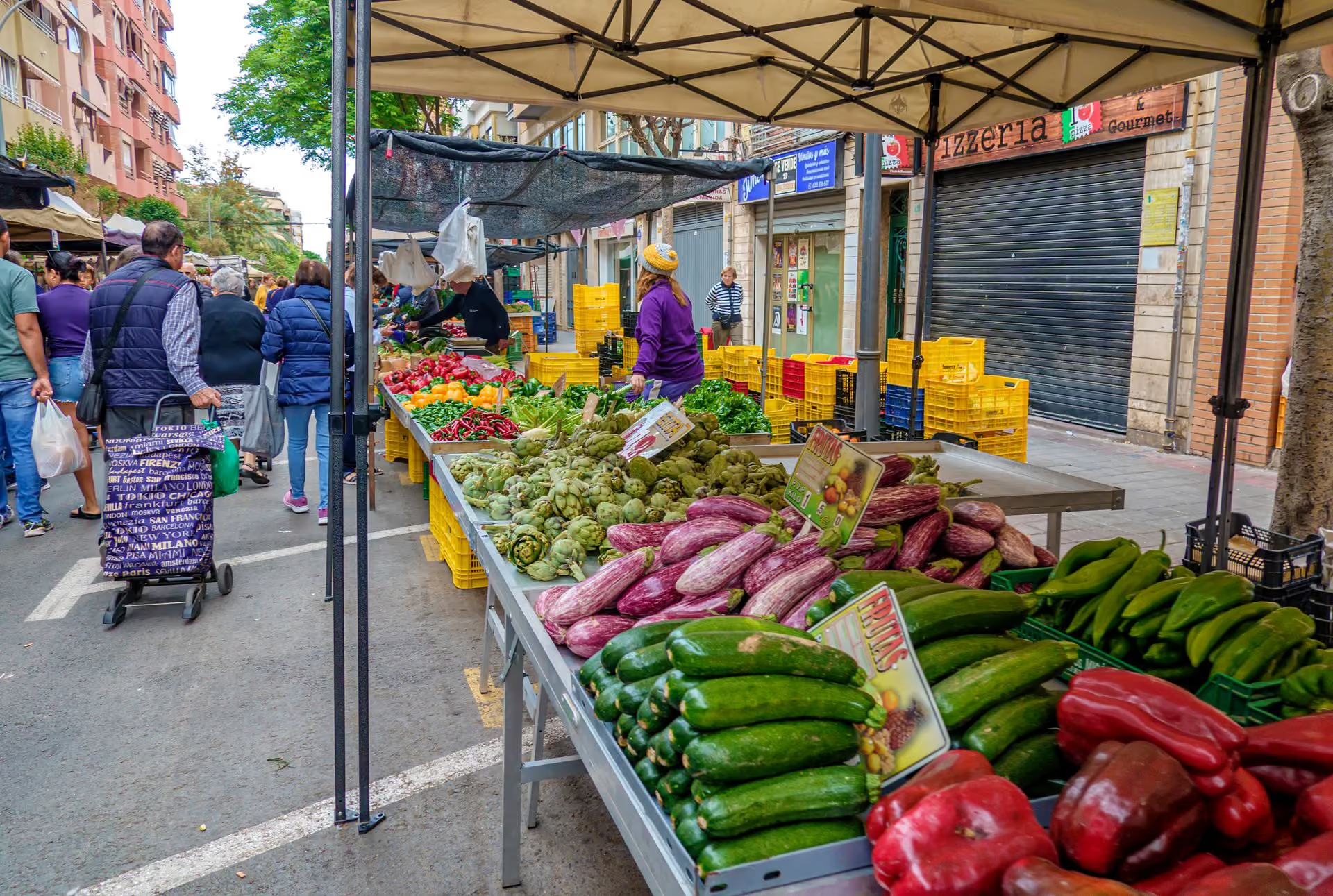
Spanish case study of alternative agri-food initiatives that use and valorise traditional agroecological knowledge from farm to fork, including seed management, local varieties, gastronomic practices, short value chains and food waste reduction.
Local initiatives across three Spanish regions, with wider implications for the Spanish agri-food system.
Practical: traditional seed selection, local variety management, gleaning, shorter value chains and culinary practices change production, distribution and consumption processes.
Political: initiatives confront public procurement rules, seed-related regulation and the need to change unsuitable legislation.
Personal: food values, taste formation, appreciation of traditional cuisine and willingness to revalue local products and heritage.
High: the initiatives connect production, commercialisation and consumption through traditional agroecological knowledge. However, amplification depends on adaptation to local context, supportive regulation and the capacity to scale values, networks and practical models together.
Traditional Knowledge for Biodiversity Conservation - Amazon Riverine Communities
Community Seed Banks - Sunday Seed Swap, Brighton & Hove, UK
Organic Farming - Bio-districts in Italy
Globally Important Agricultural Heritage Systems - Olive Groves, Italy
Agroforestry - Agroforestry Concessions in the Peruvian Amazon
TIMs Summary
The strongest evidence in the source material is for Knowledge, Biophysical Resources, Information/ Education, Financial/ Market-Based tools and Choice Architecture. The initiatives use traditional agroecological knowledge to maintain agrobiodiversity, support shorter value chains, reduce food waste and reshape how consumers learn about, select and prepare food.
Regulatory tools are clearly relevant, but mainly as barriers or enabling conditions around procurement and seed legislation rather than as a strongly institutionalised intervention package. Social Norms and Emotional Appeal are also important through heritage, authenticity, taste and the cultural status of traditional cuisine, whereas Technology is weakly evidenced.
Overall, this configuration indicates a mainly epistemic, cultural and distributive transformative pathway in which farm-to-fork knowledge and value reconfiguration are central to changing the agri-food system.
Implications for Intervention Mix Design
To enhance transformative scope, the current knowledge- and practice-based initiatives would need stronger alignment with supportive Regulatory arrangements and wider enabling infrastructures for distribution, exchange and local commercialisation. The case also suggests that Financial/ Market-Based and Choice Architecture tools can be effective when tied to local culture and food skills, rather than treated as stand-alone market devices. Transformation therefore depends not only on preserving traditional knowledge, but on embedding it across production, commercialisation and consumption.
TIMs Matrix
| Tool Category | Examples | How it ENABLES (mechanisms) | How it HINDERS (barriers) | Opportunities to strengthen | Risks / caveats | Additional suggestions and resources |
|---|---|---|---|---|---|---|
| Regulatory | The source material identifies contradictory or restrictive legislation as a recurrent barrier, including seed production requirements that favour large seed companies and public procurement rules that privilege price over quality in school canteens. | Where favourable legislation and administrative support exist, they can enable the legal consolidation and operation of local initiatives. | Current rules can restrict shorter value chains, seed exchange and the inclusion of local quality criteria in institutional food provision. | The source material explicitly points to the need for changing unsuitable legislation if these initiatives are to scale successfully. | If legal frameworks continue to privilege standardisation and price competition, local varieties and associated knowledge remain vulnerable to erosion. | Public procurement reform; seed exchange and seed access governance. |
| Financial / Market-Based | Initiatives use own-brand local products, fish baskets and other short value chain strategies; some study participants link willingness to pay more for local products to successful value change. | The financial mechanisms create additional value for local products, reduce dependence on intermediaries and can make sustainable production financially more viable. | Low market prices, intermediary power and food left unharvested because it is too ripe or not marketable all constrain the initiatives. | Social marketing and branding strategies that communicate the environmental and social value of products beyond price alone. | The commercialisation of terms such as ‘organic’ and ‘local’ by larger actors may weaken the transformative distinctiveness of the initiatives. | Short value chains; local branding; basket schemes. E.g., short value chains with modest price premia that reflect traditional agroecological practices, funded by these consumer premia together with public and EU rural-development support and occasional agroecology-focused grants and philanthropy – so producers can cover higher labour and diversity costs while consumers still access culturally familiar foods. |
| Information / Education | The initiatives provide rural educational processes, agricultural training, cooking workshops, recipe books and school canteen support to shift diets and knowledge. | The educational activities transmit traditional agroecological and culinary knowledge, helping producers and consumers understand how to grow, process and prepare local products. | The source material highlights declining cooking habits and unfamiliarity with local varieties and species, which makes uptake more difficult. | Expanding educational processes that connect production knowledge with culinary and consumption knowledge. | If knowledge transfer weakens, local varieties may remain available but commercially and culturally underused. | Rural education programmes; culinary workshops; school canteen accompaniment. |
| Choice Architecture | Fish baskets were designed for consumers who did not know what fish to order, and school menus were changed gradually so children could become accustomed to unfamiliar tastes such as beetroot. | The initiatives make sustainable and seasonal choices easier by structuring what is offered and how people encounter products without removing choice. | Consumer unfamiliarity with seasonal species and lack of processing knowledge can still limit uptake if the design is not supportive enough. | The source material supports basket schemes, phased menu changes and other structured arrangements that ease the transition to local and traditional products. | If choice designs are not adapted to local culinary culture, they may fail to build lasting demand. | Seasonal basket schemes; school menu redesign; curated local product offers. |
| Social Norms | The source material highlights a growing interest in gastronomy, the revaluation of traditional cuisine and the importance of networking and collaboration among initiatives. | The changing social norm dynamics help normalise interest in local food, agrobiodiversity and culinary heritage and can support the legitimacy of alternative agri-food practices. | Several initiatives report that society is reserved toward new ideas and tastes and that rivalry or mistrust with other initiatives can hinder development. | Umbrella networks and collaborative spaces that spread practices and mutual support. | Trend-driven interest in food may be unstable and may not translate into long-term system change on its own. | Seed networks; collaborative agri-food platforms; community gastronomy events. |
| Emotional Appeal | The initiatives draw on authenticity, familiarity, cultural identity, memories and pleasure associated with traditional cuisine and Mediterranean diet practices. | The cultural meanings help create attachment to local products and can support willingness to adopt or pay for them. | Consumers may resist unfamiliar tastes or perceive innovation as a threat if it appears to replace rather than enrich tradition. | Framing new products and practices as compatible with, and enriching of, traditional cuisine. | Strong attachment to existing tastes can also narrow acceptance of novel but compatible sustainable products. | Heritage-based food communication; traditional recipe revival. |
| Technology | ||||||
| Infrastructure (Hard/Soft) | The source material refers to networks such as the Red de Semillas and to collective arrangements such as Parque Agrario de Gallecs and school canteen linkages as enabling structures. | The initiatives' soft infrastructures support seed exchange, coordination, local commercialisation and the connection of producers with schools and consumers. | The initiatives also face professionalisation constraints and limited capacity, which can weaken the durability of these infrastructures. | Strengthening networks and collaborative structures that connect the different stages of the agri-food system. | If these infrastructures remain thinly resourced, scaling out can place excessive pressure on small teams. | Seed exchange networks; agroecological parks; local distribution and school-food linkages. |
| Biophysical Resources | Local seed varieties, seasonal fish, algae, phytoplankton and gleaned fruit and vegetables all feature as resources within the initiatives. | The initiatives' biophysical resources support agrobiodiversity, alternative protein options, reduced food waste and shorter, more place-based food chains. | Linkages between industrial agriculture and dietary change to biodiversity loss, genetic erosion and the erosion of the practices that maintained these resources. | The source material explicitly supports adapting and exchanging local varieties and using underused species and leftovers more effectively. | If the knowledge associated with these resources erodes, the resources themselves become harder to maintain and valorise. | Agro-biodiversity conservation; gleaning; plant-based marine ingredients. |
| Knowledge | Traditional agroecological knowledge appears in seed selection, farming techniques, culinary knowledge, quality assessment, fish processing and cooking practices. | Traditional knowledge connects farm and fork, allowing local varieties and species to be grown, recognised, processed, commercialised and consumed in meaningful ways. | Erosion of traditional practices and knowledge, including reduced cooking skills and weaker familiarity with local products. | Recognising knowledge across the whole agri-food system and for hybridising traditional and scientific forms of knowledge. | Treating tradition as static or obsolete can undermine its adaptive and innovative role. | Farm-to-fork knowledge transmission; hybrid traditional–scientific learning. |
| Other | The initiatives include grassroots organisations, social entrepreneurs and public-private partnerships, many of which act across several stages of the agri-food system at once. | The hybrid organisational forms help connect production, commercialisation, education, waste reduction and cultural revitalisation within one initiative. | The source material identifies lack of business experience, internal tensions over motivation and the challenge of professionalisation as recurrent constraints. | Networking, collaboration and adaptation as ways to consolidate and extend the organisational models. | If internal tensions are not managed, organisational hybridity can become a source of fragility rather than strength. | Social entrepreneurship; grassroots agri-food collectives; public-private partnerships. |
Note: Blank cells reflect that the documentary evidence available for this case did not contain sufficiently explicit information to address these dimensions. This absence should not be interpreted as implying that such mechanisms were irrelevant or ineffective, but simply that they were not documented within the scope of the source materials.
References
Guerrero Lara, L., Pereira, L. M., Ravera, F., & Jiménez-Aceituno, A. (2019). Flipping the tortilla: Social-ecological innovations and traditional ecological knowledge for more sustainable agri-food systems in Spain. Sustainability, 11(5), 1222. https://doi.org/10.3390/su11051222