


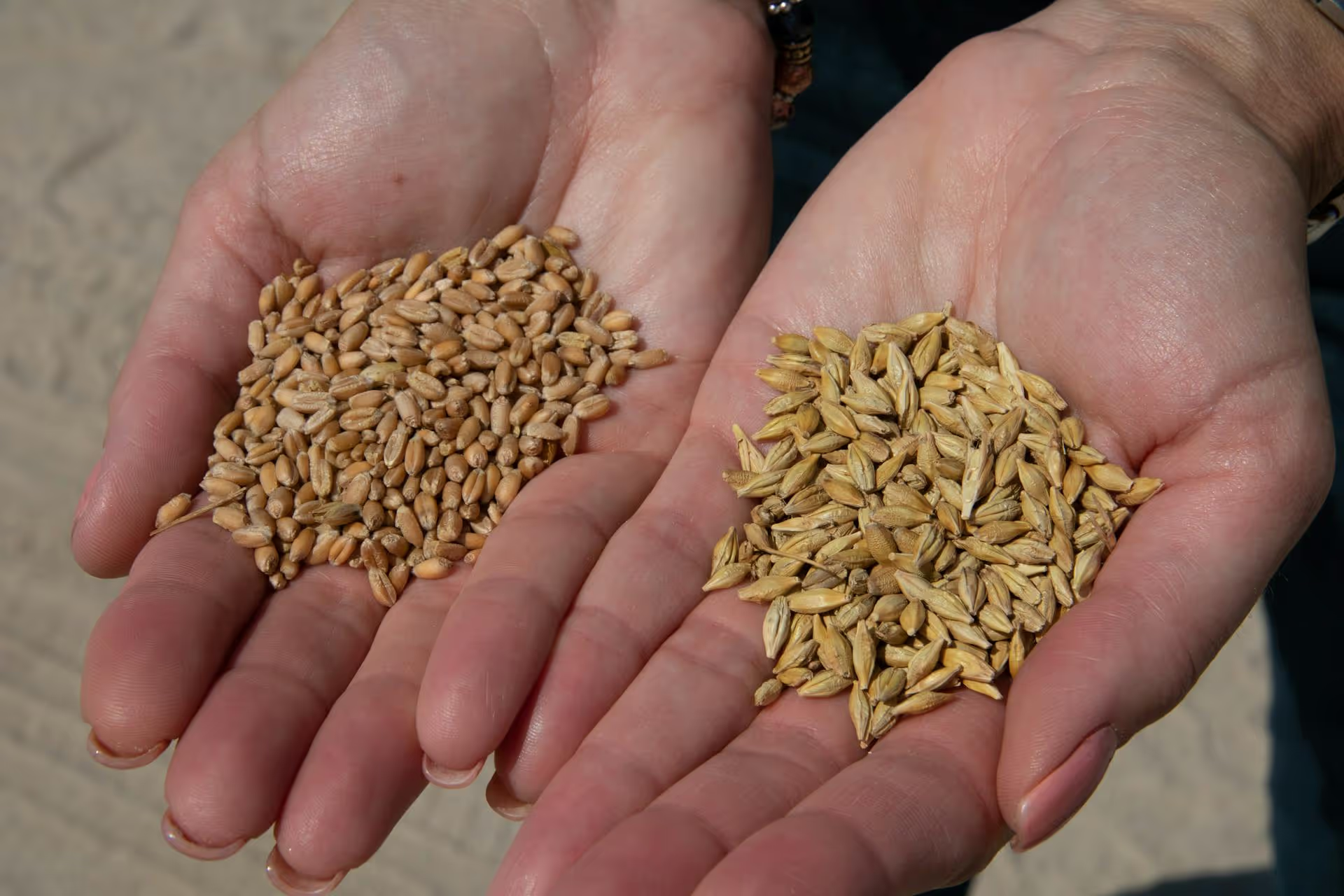
Seedy Sunday Seed Swap, Brighton & Hove, UK
.svg)
This case innovation has been analysed using the Transformative Intervention Mixes (TIMs) framework. The framework maps the regulatory, economic, social‑behavioural, technological and material interventions at play, clarifying how these elements interact and what this configuration suggests about the innovation’s capacity to support transformative change.
The case analysis draws primarily on evidence synthesised from:
Balázs et al. (2015), Pottinger (2016) and https://bhfood.org.uk/seedy-sunday/
Overview
Community Seed banks
Seedy Sunday (Brighton & Hove, UK) – community seed swap event and related campaigning
Agrobiodiversity, local food growing, seed saving and exchange; civic action on seed regulation
A volunteer-run seed swapping initiative embedded in local growing communities and activist networks, with episodic engagement in broader European campaigns over seed regulation.
Local annual event (seed swap, stalls, talks) with transnational linkages through campaigns and seed networks.
Practical: seed saving and swapping practices enabling access to diverse seeds and skills for local growers.
Political: involvement in campaigning against proposed EU seed regulation reforms, contributing to wider mobilisation and parliamentary outcome.
Personal: learning-oriented and identity-linked participation (e.g., pride in saving/sharing ‘weird and wonderful’ varieties) and encouragement of newcomers through a non-exacting ethos.
Sources indicate amplification depends on sustaining volunteer capacity and organisational robustness as events grow; governance adjustments (delegation clarity, training, facilitated away days, term limits) are used to manage this, but require continual replenishment of organisers.
TIMs Summary
The case is strongly evidenced for Voluntary-advisory-educational, Social Norms, and Knowledge tools through a recurring seed swap event that organises learning, peer support, and shared expectations around seed saving and exchange. Political engagement is evidenced via campaigning against tightened seed regulation proposals, linking local practice to transnational contestation over legal constraints. Financial/Market-based tools are present in modest form (entrance fees and stall charges to cover costs), but not as incentive instruments aimed at wider behavioural change. Regulatory tools appear primarily as external constraints (seed registration law; proposed reforms) rather than as instruments designed by the initiative.
The configuration implies a pathway that is primarily relational and epistemic - building skills, confidence, and community infrastructures - while periodically scaling into political mobilisation when legal threats directly target the practice.
Implications for Intervention Mix Design
Seedy Sunday’s current mix uses community practice plus learning infrastructures to sustain seed diversity and participation, with political mobilisation activated under regulatory threat. To enhance transformative scope, additional alignment would be required with supportive regulatory arrangements and durable resourcing mechanisms that reduce reliance on volunteer labour, without implying these are currently implemented. Complementary attention would also be needed to infrastructural and inclusion constraints (space, coordination, and newcomer support) that the sources identify as growing pains.
TIMs Matrix
| Tool Category | Examples | How it ENABLES (mechanisms) | How it HINDERS (barriers) | Opportunities to strengthen | Risks / caveats | Additional suggestions and resources |
|---|---|---|---|---|---|---|
| Regulatory | Seed registration law is described as being circumvented through donation-based swapping; proposed EU reforms (2012) would have outlawed seed swapping practices. | External legal frameworks define what forms of seed exchange are permitted; legal threat can trigger mobilisation and adaptation of practices. | Regulatory tightening is a direct barrier, potentially rendering core practice illegal. | Political campaigning is documented as a response pathway when regulation threatens practice. | Legal ambiguity can expose organisers and participants to compliance risks. | Complement with formal policy advocacy coalitions and legal guidance services for community seed initiatives. |
| Financial / Market-Based | Entrance fee (kept low; children free) and stall charges to cover event costs; donation (£0.50) option for those without seeds. | Low entrance fee generates modest revenue to sustain the event while keeping participation accessible; donation mechanism enables exchange without commercial sales framing. | Growing organisational demands can exceed what low fees and volunteer labour can sustain. | Clarifying delegated responsibilities and improving volunteer training are documented organisational responses (resource-lean strengthening). | Financial fragility may limit continuity and increase burnout risk. | Complement with stable sponsorship or grant support mechanisms. |
| Information / Education | Talks, speakers, cooking demonstrations, and volunteer/community group advice at the event; encouragement of newcomers with an explicitly non-exacting approach. | Educational/ information activities build skills and confidence in seed saving, local growing, and practical participation through peer learning and demonstrations. | Novices may face confusion about seed quality and germination, which is acknowledged in event materials. | Provision of clearer signposting and volunteer briefing/ training is documented as events scaled. | Misinformation or low-quality seed exchange can undermine trust and participation. | Complement with simple quality labelling guidance and follow-up support channels. |
| Choice Architecture | Seed swap tables with low-cost donation option for non-contributors; event layout and signposting improvements as organisation professionalised. | The initiative structures participation so newcomers can engage without prior seed stocks, reducing entry barriers and making exchange salient. | Poor organisation/ layout can reduce accessibility and increase confusion, requiring continuous improvement. | Clearer arrangements and signposting are documented as strengthening actions. | Over-structuring could reduce the informal, welcoming ethos that supports participation. | Complement with user-tested event flows that preserve openness while improving accessibility. |
| Social Norms | Volunteer coalition drawn from grower associations and activist networks; norms of sharing seeds and supporting community growing. | The initiative reinforces expectations that saving and sharing seeds is legitimate, communal, and desirable, sustaining ongoing participation. | Norm conflict and tensions arise as diverse viewpoints meet; reconciliation work is sometimes needed. | Deliberate committee refresh and rotating chairing are documented to sustain inclusive norms. | Strong subcultural norms may unintentionally exclude less-connected participants. | Complement with outreach partnerships that broaden participation beyond existing networks. |
| Emotional Appeal | Pride and attachment to ‘weird and wonderful’ varieties; community celebration framing of a ‘much-loved’ event. | The initiative uses conviviality and positive affect to motivate participation and sustained volunteer commitment. | Emotional investment can amplify conflict when organisational tensions emerge. | Facilitated away days are documented as a mechanism to navigate difficult organisational decisions. | Burnout risk increases if affective labour substitutes for resourcing. | Complement with volunteer wellbeing and recognition practices. |
| Technology | ||||||
| Infrastructure (Hard/Soft) | Volunteer committee structure with delegated responsibilities; facilities for seed tables, stalls, café, and activities; training and day-running arrangements. | The initiative provides organisational infrastructure enabling a large-scale community exchange event and coordination of multiple activities and stakeholders. | Scaling increases coordination complexity and dependence on a small core of organisers. | Documented strengthening includes clearer delegation, volunteer training, improved space organisation and signposting, and constitutional term limits. | Over-professionalisation risks diluting grassroots character and accessibility. | Complement with lightweight digital coordination tools and succession planning supports. |
| Biophysical Resources | Exchange of saved seeds and access to diverse varieties through swapping tables; link to community growing and allotment networks. | The initiative alters access to planting materials, enabling more diverse cultivation and local experimentation. | Seed quality variability and limited germination are acknowledged; diversity can include mislabelling/cross-pollination outcomes. | Encouraging basic rules and learning about seed saving is evidenced as part of practice strengthening. | Uncontrolled exchange can spread pests/diseases or undesirable traits. | Complement with basic biosecurity and provenance guidance. |
| Knowledge | Experience-based learning and sharing at the event; campaigns that translated regulatory threats into accessible public narratives. | The initiative creates shared understanding of seed saving, legal constraints, and the value of agrobiodiversity, supporting collective action. | Knowledge gaps for newcomers can reduce confidence and perceived success. | Ongoing education and peer support are integral and explicitly documented. | Politicisation of knowledge claims can polarise participants. | Complement with accessible, evidence-based seed saving resources linked to the event. |
| Other | International campaigning that contributed to the EU Parliament voting down proposed reforms (March 2014). | A hybrid model combining local leisure-based volunteering with episodic political mobilisation when practice is threatened. | Campaign intensity may not be sustainable on a volunteer basis. | Use of transnational networks is implied as a resource during regulatory threats. | Campaign framing can over-simplify complex policy debates. | Complement with specialised advocacy organisations and legal expertise partnerships. |
Note: Blank cells reflect that the documentary evidence available for this case did not contain sufficiently explicit information to address these dimensions. This absence should not be interpreted as implying that such mechanisms were irrelevant or ineffective, but simply that they were not documented within the scope of the source materials.