


Hands-Free Hectare, UK
.svg)
This case innovation has been analysed using the Transformative Intervention Mixes (TIMs) framework. The framework maps the regulatory, economic, social‑behavioural, technological and material interventions at play, clarifying how these elements interact and what this configuration suggests about the innovation’s capacity to support transformative change.
The case analysis draws primarily on evidence synthesised from:
Overview
Smart agriculture
Hands-free hectare
Arable crop production; agricultural engineering; precision and autonomous farming systems
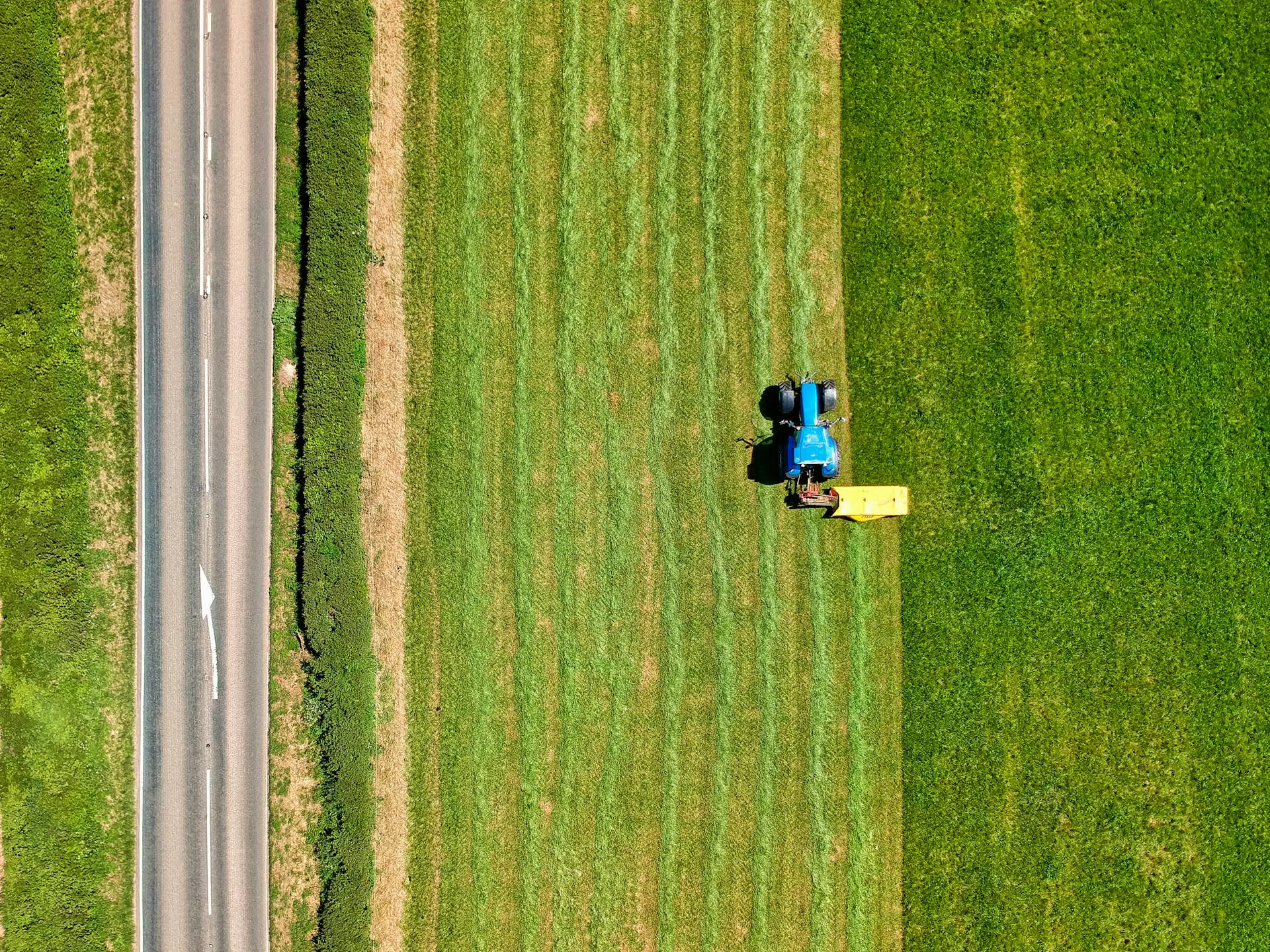
A Harper Adams University and Precision Decisions demonstrator in Shropshire, England, designed to show that an arable crop could be planted, monitored and harvested using autonomous machinery. The project retrofitted conventional equipment with GNSS guidance, open-source drone software, sensors and remote control, while keeping agronomy deliberately conventional to maximise technical feasibility.
Experimental field scale at first (one hectare), later extending to multi-field autonomous demonstrations and wider sector outreach through shows, media coverage and follow-on development.
Practical: Demonstrated autonomous drilling, spraying, monitoring and harvesting, improved field accuracy, and showed that smaller machines can support precise field operations.
Political: Attracted support from public and industry bodies and fed wider debate on the responsible development, testing and promotion of autonomous farming.
Personal: The project explicitly sought to change farmer, industry and public perceptions of what autonomous arable farming could achieve, using demonstrations and intensive communication.
Medium-high: the case demonstrated technical feasibility and strong communicative value, but broader uptake depends on reliability in less simplified field conditions, further safety and regulatory development, stronger business cases, and integration with whole-farm logistics.
TIMs Summary
Hands-free hectare is most strongly evidenced as a technology-led intervention, supported by knowledge generation, voluntary demonstration, and carefully simplified operational choices. The strongest tools are the retrofitted autonomous machines, drones, guidance systems and agronomic data flows that allowed the team to complete drilling, spraying and harvesting with minimal direct human intervention. Information and educational tools were also central, because the project was intentionally public-facing and used demonstrations, talks and social media to shift sector expectations. By contrast, regulatory and market-based mechanisms were present but weaker in the named sources, appearing mainly as enabling conditions, funding support and emerging discussions around responsible deployment.
This configuration suggests a primarily socio-technical and epistemic pathway of transformation in which proof-of-concept, visibility and iterative learning precede large-scale institutionalisation; implementation will depend on moving from a simplified test environment to more variable farm conditions without losing reliability.
Implications for Intervention Mix Design:
To widen transformative scope, the existing technology-and-knowledge mix would need stronger alignment with regulatory frameworks, infrastructure for data and machine logistics, and market instruments that reduce adoption risk for farms beyond the demonstration setting. More explicit links to farmer training, cooperative service models and responsible governance could help move the intervention from symbolic proof to routine practice.
| Tool Category | Examples | How it ENABLES (mechanisms) | How it HINDERS (barriers) | Opportunities to strengthen | Risks / caveats | Additional suggestions and resources |
|---|---|---|---|---|---|---|
| Regulatory | Limited but explicit references to testing codes, risk management and wider policy interest in autonomous farming. | The regulatory conditions create a permissive environment for experimentation and help frame autonomy as a legitimate area for agricultural innovation. | The case itself still operated mainly as a demonstrator, so regulatory arrangements were not yet a strong driver of field-scale adoption. | Translate pilot lessons into clearer farm-safety, liability and road-to-field operating protocols for autonomous machines. | Regulatory lag could slow commercialisation or create uncertainty over responsibility when systems fail. | Responsible development frameworks for autonomous robotics; farm safety and testing protocols. |
| Financial / Market-Based | Agriculture and Horticulture Development Board (AHDB) funding for the second season; low-budget retrofitting of off-the-shelf machinery; anticipated gains from lower labour demand and better field coverage. | External funding reduced experimentation risk and allowed the project to prove feasibility without waiting for fully commercial robotic systems. | The economic case beyond demonstration remained conditional on reliability, supervision needs and the cost of scaling to commercial farms. | Develop clearer service, leasing or contractor models for autonomous operations and test them under commercial conditions. | If capital and maintenance costs remain high, benefits may be captured unevenly or stay confined to showcase projects. | Precision agriculture investment support; contractor-based machinery services; innovation grants. |
| Information / Education | Open-source and transparent development; public talks, farm shows, interviews and social media; field-to-fork demonstration around harvest. | Communication accelerated learning, built legitimacy and broadened awareness among farmers, researchers, policymakers and the public. | Public attention can outpace technical maturity, and time spent on communication can compete with engineering refinement. | Pair demonstrations with structured farmer training and practical guidance on where autonomy works well and where it does not. | Overselling immature systems could create backlash if performance in ordinary farm conditions disappoints. | Technical advisory networks; demonstration farms; farmer-led innovation exchange. |
| Choice Architecture | The project deliberately simplified the field environment to a flat, rectangular hectare and used conventional seed, fertiliser and pesticide plans with predetermined machine paths. | The simplified field environment reduced technical complexity and increased the probability of success, allowing the team to focus on integration rather than on every agronomic variable at once. | The simplified field environment limits transferability because many commercial farms operate across more complex field shapes, soils and logistics. | Use staged trials that progressively introduce greater environmental and operational complexity while retaining clear performance benchmarks. | A design that works mainly in simplified environments may create misleading expectations about immediate scalability. | Adaptive task routing, phased implementation and supervised autonomy models. |
| Social Norms | Team-based demonstrations, farm shows and broad media exposure created a visible narrative that autonomous arable farming was becoming credible. | Public visibility helped normalise discussion of robotics in commodity cropping and encouraged wider sector engagement. | Novelty can produce attention without durable adoption if peers do not see workable business models. | Support peer-to-peer learning between demonstrator farms, contractors and early adopters. | Media-driven enthusiasm may privilege spectacle over careful assessment of costs, risks and supervision needs. | Farmer discussion groups; sector showcases; collaborative innovation networks. |
| Emotional Appeal | The ‘world-first’ framing, harvest demonstrations and field-to-fork storytelling gave the case a strong sense of excitement and possibility. | The framing strategy strengthened stakeholder engagement and helped the project mobilise support beyond the engineering community. | Excitement alone cannot substitute for reliability, safety and workable economics. | Keep communication grounded in clearly reported limitations as well as achievements. | Hype may obscure unresolved issues and reduce trust if the technology matures slowly. | Public engagement activities linked to on-farm innovation and responsible technology use. |
| Technology | Retrofitted tractor and combine, GNSS/RTK (Global Navigation Satellite System/ Real-time kinematic positioning) guidance, drones, remote control, autopilot systems and later autonomous unloading on the move. | The project’s technologies enabled end-to-end arable operations, improved driving accuracy and generated agronomic information for management decisions. | Performance still depended on remote oversight, simplified settings and unresolved technical challenges, especially outside the original hectare. | Integrate robotic scouting, stronger perception systems, and more robust shed-to-field navigation and obstacle interaction. | Model drift, positioning errors, software failure and interoperability problems remain material risks. | Precision agriculture sensors; robotic scouting; autonomous logistics integration. |
| Infrastructure (Hard/Soft) | Use of conventional machinery as retrofit platforms; access to a dedicated test field; project partnership between university and commercial agronomy provider. | Existing farm infrastructure lowered entry barriers and made the demonstrator more practical than a fully bespoke robotic system. | Commercial uptake will require repair, servicing, data handling and operational support infrastructure beyond a research team. | Build regional support ecosystems for servicing, data management and supervised deployment. | Weak support infrastructure could make breakdowns expensive and undermine farmer confidence. | Demonstration farms; shared servicing hubs; university–industry innovation partnerships. |
| Biophysical Resources | A flat rectangular field, conventional barley and wheat systems, and later use of a cover crop while the site served as a test space. | Managing biophysical conditions conservatively helped isolate the technological challenge and achieve a complete cropping cycle. | Weather remained a constraint, and the field setting did not capture the full variability of commercial landscapes. | Test autonomy in more diverse field shapes, soils and cropping systems, including regenerative and strip-cropping contexts. | Results from simplified sites may not transfer cleanly to more heterogeneous landscapes. | Cover crops; strip cropping; diversified arable demonstrations. |
| Knowledge | Drone imagery, soil and crop sampling, yield mapping and iterative engineering learning across repeated seasons. | The case produced operational knowledge about how autonomy components could be combined quickly and credibly in arable systems. | Knowledge was still strongly project-specific and dependent on a small expert team. | Formalise learning into open protocols, decision guides and comparative trials under commercial conditions. | If tacit knowledge stays concentrated in a few specialists, diffusion may remain slow. | Applied farm engineering research; precision agronomy; open documentation and training. |
| Other | A hybrid of scientific experiment, engineering integration, and strategic communication. | The scientific-engineering-communication combination allowed the case to work simultaneously as a technical trial and as a narrative intervention for sector change. | The dual role can blur whether success is being measured in technical, economic or symbolic terms. | Separate technical performance evaluation from communication outcomes more explicitly in future phases. | Ambiguity over objectives can complicate claims about readiness and impact. | Living labs and mission-oriented innovation platforms. |
Note: Blank cells reflect that the documentary evidence available for this case did not contain sufficiently explicit information to address these dimensions. This absence should not be interpreted as implying that such mechanisms were irrelevant or ineffective, but simply that they were not documented within the scope of the source materials.