


Promoting Environmental Climate Citizenship
.svg)
This case innovation has been analysed using the Transformative Intervention Mixes (TIMs) framework. The framework maps the regulatory, economic, social‑behavioural, technological and material interventions at play, clarifying how these elements interact and what this configuration suggests about the innovation’s capacity to support transformative change.
The case analysis draws primarily on evidence synthesised from:
Santoso & Bailenson (2024)
Overview
Virtual reality (VR)
Promoting environmental climate citizenship
Climate change communication and education; environmental behaviour change; immersive digital engagement
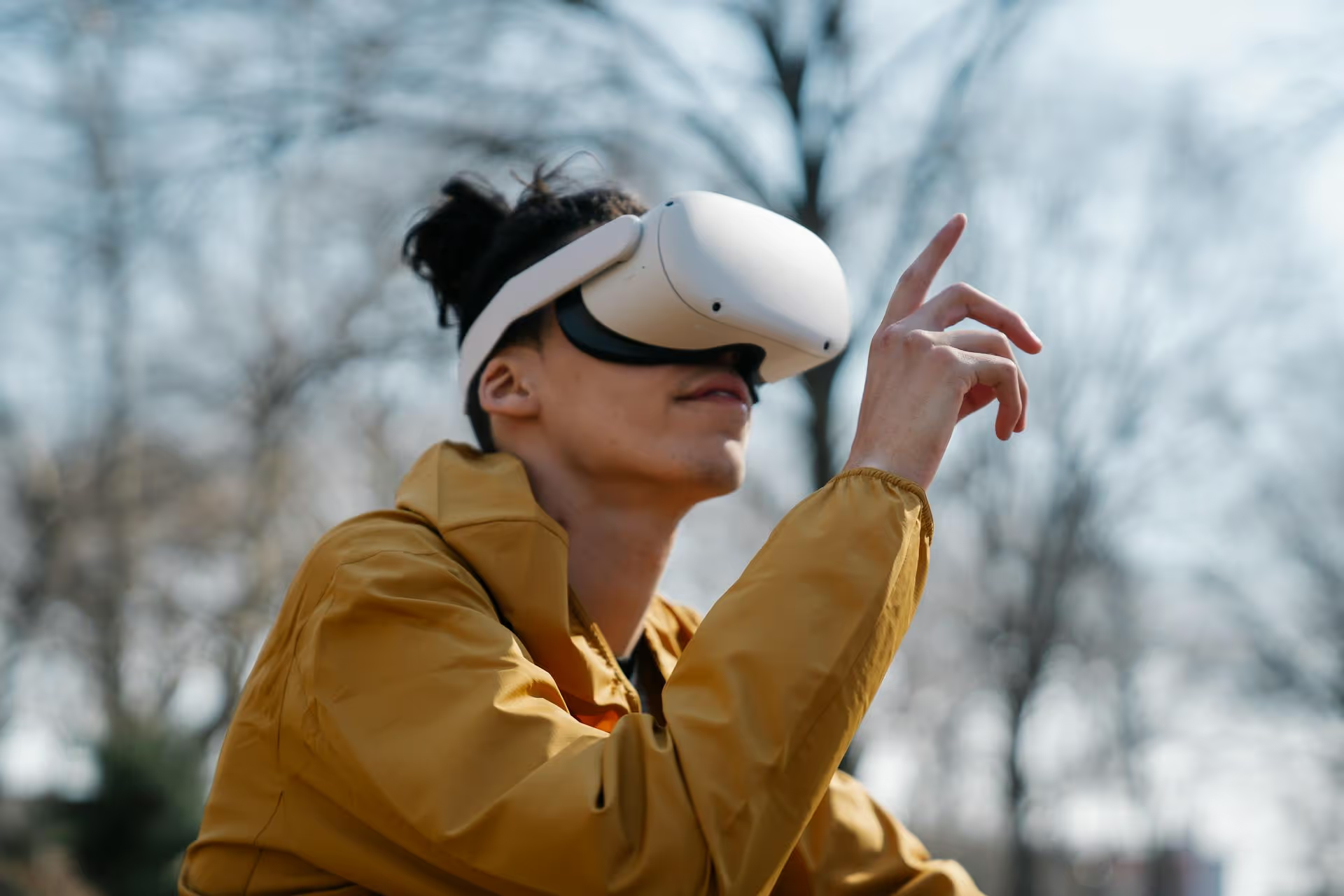
This case reviews immersive virtual reality as a medium for promoting environmental climate citizenship through preserving biodiversity, adopting environment-friendly habits and behaviours, and supporting policy engagement. The intervention works through immersion, presence, embodiment and perspective-taking, allowing users to experience distant, dangerous or otherwise inaccessible environmental situations in more immediate ways than conventional media.
Intervention and research-programme scale across multiple countries, populations and experimental settings rather than a single place-based implementation.
Practical: Supports shifts in learning, risk perception and some pro-environmental behaviours such as waste sorting, dietary change, donations and conservation actions.
Political: Provides evidence that immersive exposure can increase support for environmental policies and sea-level planning, although results vary by design and context.
Personal: Strongly evidenced through changes in presence, empathy, emotional response, self-efficacy, connection to nature and perceived psychological distance.
High in principle because the medium is portable across topics and settings, but amplification depends on careful design, appropriate use cases and avoiding experiences that produce hopelessness, scepticism or weak transfer to real-world action.
TIMs Summary
The evidence is strongest for technology, information and education, emotional appeal and knowledge, with additional moderate evidence for choice architecture through the design of immersive tasks and exposure conditions. Social-norm and regulatory mechanisms are weakly evidenced, and there is little support in the named source for direct market-based or biophysical-resource tools because the intervention is primarily communicative and experiential rather than materially redistributive. The review repeatedly shows that virtual reality does not act automatically: outcomes depend on factors such as presence, embodiment, risk perception, trust, narrative engagement and self-efficacy, and can be positive or counterproductive.
This configuration implies a transformative pathway that is mainly cognitive and affective, seeking to reduce psychological distance and make climate-related issues feel immediate, actionable and personally meaningful. An implementation-relevant lesson is that the design of the experience matters more than immersion alone.
Implications for Intervention Mix Design:
To widen transformative scope, VR would need stronger alignment with complementary social, institutional and policy instruments that convert attitude and learning gains into durable behavioural and governance outcomes. More explicit social-norm approaches, follow-on community action and integration with formal education or public decision processes would likely strengthen real-world persistence.
TIMs Analysis
| Tool Category | Examples | How it ENABLES (mechanisms) | How it HINDERS (barriers) | Opportunities to strengthen | Risks / caveats | Additional suggestions and resources |
|---|---|---|---|---|---|---|
| Regulatory | ||||||
| Financial / Market-Based | ||||||
| Information / Education | Climate education modules on ocean acidification, biodiversity, waste, food footprints and sea-level rise; school and museum-oriented VR learning activities. | VR provides immersive learning that can improve knowledge, self-efficacy and understanding of climate-related processes that are otherwise abstract or distant. | Educational gains do not always translate into sustained behaviour change, and some content is too complex without facilitation or prior framing. | Combining VR with pre-training, curriculum links and follow-up discussion could improve retention and transfer. | The persuasive force of the medium may be overstated if learning is measured only immediately after exposure. | Climate education programmes; museum learning tools; place-based environmental communication. |
| Choice Architecture | Design choices such as framing, segmentation, standing versus sitting, embodiment, routing of attention and task structure within immersive environments. | These design elements shape what users notice, how they move, what they feel capable of doing and whether behaviourally relevant information is salient. | Poorly calibrated design can reduce learning, intensify fatigue or even lower risk perception and engagement. | More deliberate design for actionability, feedback and user-centred progression could strengthen outcomes. | Design-led effects may be mistaken for general properties of VR, masking important contextual variation. | Behaviourally informed interface design; guided immersive learning; action-oriented digital communication. |
| Social Norms | The review notes sociopolitical barriers linked to lack of in-group support for pro-environmental behaviour, but provides limited direct evidence of VR explicitly targeting norm change. | VR could in principle support shared identity and civic participation, but explicit norm-based mechanisms are not strongly developed in the named source. | Because norm interventions are weakly evidenced, changes in individual attitudes may remain socially isolated. | Pairing VR with group deliberation, school or community activities and visible collective commitments could strengthen norm formation. | Without collective reinforcement, effects may remain short-lived and personalised. | Community climate challenges; classroom discussion; civic participation formats. |
| Emotional Appeal | Awe-inspiring nature scenarios, wildlife embodiment, wildfire simulations, immersive nature exposure and empathy-inducing perspective-taking. | These experiences can increase connection to nature, empathy, concern, presence and sometimes donation intentions or pro-environmental intentions. | Emotional effects are not uniformly positive; some studies reported hopelessness, lower engagement or weak translation into action. | Designing emotional content alongside efficacy cues and realistic action pathways would improve constructive motivation. | Highly affective experiences can overwhelm users or privilege spectacle over meaningful learning. | Immersive storytelling; empathy-building experiences; awe-based conservation communication. |
| Technology | Head-mounted displays, 360-degree video, immersive virtual environments, motion tracking and embodied avatars. | The intervention depends directly on these technologies to create immersion, presence and embodiment that conventional media cannot match in the same way. | Technical quality, cost, portability and user discomfort can shape who can participate and how effective the experience is. | Improving access, portability and design quality could expand reach while preserving experiential depth. | Technology-centred approaches may exclude some users and can distract from the broader intervention mix needed for change. | Immersive learning systems; virtual field trips; embodied simulation tools. |
| Infrastructure (Hard/Soft) | Educational settings, museums, labs and outreach contexts that host VR experiences; digital platforms for content delivery. | Institutional settings make it possible to deploy VR repeatedly, integrate it into lessons and connect it to broader learning goals. | Many studies remain experimental or project-based, limiting routinisation and long-term embedding. | Stable partnerships with schools, museums and public institutions could strengthen continuity and scale. | Infrastructure-heavy deployment may privilege well-resourced settings and widen access gaps. | Museum programmes; school-based immersive learning; public communication infrastructure. |
| Biophysical Resources | ||||||
| Knowledge | Synthesis of studies on biodiversity, behaviour, risk perception, learning and policy support in immersive settings. | Knowledge functions both as intervention content and as the basis for refining how VR should be used to address climate-related psychological barriers. | The field is still uneven, with many studies measuring intentions rather than lasting real-world behaviour. | Longer-term behavioural tracking and better integration of objective measures would strengthen the knowledge base. | Weak evidence on persistence may lead to overclaiming the medium’s practical impact. | Environmental psychology; climate communication research; evaluation of immersive interventions. |
| Other | Environmental citizenship as the organising framework linking biodiversity, behaviours and policy support. | The case's environmental citizen framework broadens the intervention beyond isolated behaviour change and connects VR to civic responsibility and governance. | The review itself notes that the evidence base is still fragmented and concentrated in a limited range of settings and populations. | Future work that connects VR more directly to participation, collective action and institutional decision-making could deepen its contribution. | A compelling framework does not guarantee implementation pathways or social inclusion. | Environmental citizenship programmes; participatory climate engagement; civic education. |
Note: Blank cells reflect that the documentary evidence available for this case did not contain sufficiently explicit information to address these dimensions. This absence should not be interpreted as implying that such mechanisms were irrelevant or ineffective, but simply that they were not documented within the scope of the source materials.