


Avanzi Popolo 2.0 NGO, Bari/Apulia, Italy
.svg)
This case innovation has been analysed using the Transformative Intervention Mixes (TIMs) framework. The framework maps the regulatory, economic, social‑behavioural, technological and material interventions at play, clarifying how these elements interact and what this configuration suggests about the innovation’s capacity to support transformative change.
The case analysis draws primarily on evidence synthesised from:
Lombardi & Costantino (2020)
Overview
Food Waste Reduction
Italian NGO (Avanzi Popolo (AP) 2.0, Bari/ Apulia)
Food waste reduction and surplus food redistribution; food sharing and community network-building
Case study of Avanzi Popolo 2.0 (run by Aps Farina 080 Onlus) in Bari and surrounding territory, combining food redistribution, an online food-sharing platform and education/sensitisation activities; analysed as a social innovation model for reducing food waste.
Primarily urban and local–territorial scale (Bari and surrounding area) with networked stakeholders (producers, processors, retailers, restaurants, families, charities and NGOs) and online community reach.
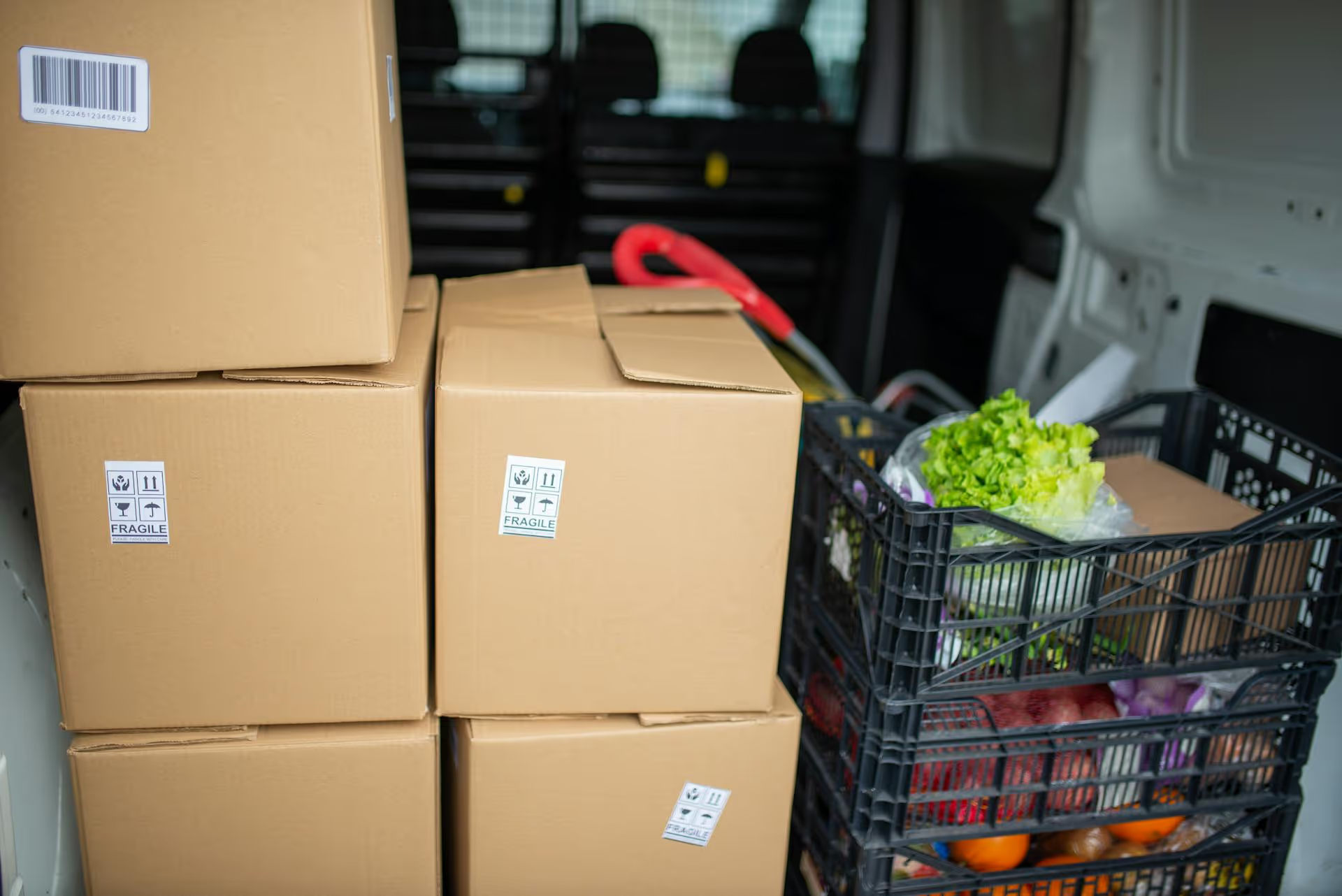
Practical: Recovery and redistribution of surplus food connecting ‘waste places’ with ‘need places’, including specific recovery streams (e.g., large restaurants during wedding parties), and facilitation of direct food exchange via an online platform.
Political: Operates within and leverages the Italian policy context on food donations (including legal simplification and fiscal incentives) and engages multiple institutions and networks.
Personal: Education and sensitisation activities are a defined pillar, aimed at shifting awareness of social, environmental and economic impacts of food waste.
Moderate to high: The model is presented as transferable as a community network and platform-based approach, with visibility and recognition (awards) supporting replication potential where stakeholder networks can be established.
TIMs Summary
The Avanzi Popolo (AP) 2.0 case is strongly evidenced in voluntary-advisory-educational, social-norm and technology tools, combining education/sensitisation with a food-sharing online platform and active network-building across heterogeneous local stakeholders. Financial/ market-based and regulatory elements are present through the Italian legal context that simplifies donation procedures and enables fiscal incentives proportional to donated food, shaping the enabling environment for redistribution activities. Choice-architecture mechanisms appear through practical arrangements for food exchange and reporting/ visibility of recovery operations, while emotional appeal is present mainly through community framing and public recognition rather than as a distinct campaign instrument. Biophysical and infrastructure tools are evidenced through the logistics of surplus food recovery and redistribution, but operational constraints (e.g., coordination burdens and bureaucracy addressed by policy changes) are highlighted as limiting factors.
Implementation-wise, the source material emphasises that social capital and the sense of community are critical enabling conditions for local food redistribution networks to function and persist.
Implications for Intervention Mix Design
The documented pathway is relational and practice-oriented, using network reconfiguration and platform-enabled exchange to reduce waste while addressing food insecurity. To enhance transformative scope, additional alignment with more formalised regulatory partnerships or stable financing mechanisms could extend durability, but these are not described as implemented components of the case. Similarly, more explicit behavioural choice-architecture design could strengthen participation and equity, without implying these instruments currently exist beyond the documented practices.
TIMs Matrix
| Tool Category | Examples | How it ENABLES (mechanisms) | How it HINDERS (barriers) | Opportunities to strengthen | Risks / caveats | Additional suggestions and resources |
|---|---|---|---|---|---|---|
| Regulatory | Italian policy context on surplus food donations includes simplification of donation procedures and permissions to donate products past best-before date and other categories; enabling legal environment is discussed in the case analysis. | Creates legal conditions that allow surplus food recovery and redistribution to operate with reduced administrative friction. | Prior bureaucracy around donations is identified as a constraint that policy changes attempt to reduce. | Continue aligning operational procedures with the described simplified donation rules to lower transaction costs for participating food operators. | Legal misunderstandings or inconsistent implementation could reintroduce administrative barriers. | Waste reduction targets; Integration of food redistribution into municipal food policy. |
| Financial / Market-Based | Fiscal incentives proportional to the amount of donated products are described as part of the 2016 legal context. | Provides economic incentives for food operators to donate surplus rather than discard it, potentially increasing supply to redistribution networks. | Effectiveness depends on awareness and administrative uptake; incentives alone may not address logistical constraints. | Fiscal incentives could concentrate participation among larger operators able to capture benefits, leaving smaller actors under-represented. | Strengthened fiscal incentives for smaller food operators, municipal support for logistics and storage, targeted subsidies for redistribution infrastructure, and dedicated public funding lines that stabilise NGO-led food waste initiatives over time. | |
| Information / Education | AP pillar (iii): educating and sensitising people about food waste social, environmental and economic impacts. | Builds awareness and norm internalisation supporting sustained participation and broader behavioural change around waste reduction. | Educational reach and evaluation of learning outcomes are not detailed in the named source description. | Awareness-raising without convenient participation pathways can lead to disengagement. | ||
| Choice Architecture | Online community enables direct exchange of food; reporting of recovery operations on a public Facebook page is described as facilitating network expansion. | Increases salience and reduces coordination frictions by making opportunities and actions visible and easier to act on. | Digital participation requires access and sustained moderation; details on governance of the online community are limited. | Maintain transparency of recovery activities as described to support trust and onboarding of new actors. | Public reporting could create privacy or reputational risks for donors/recipients if not managed. | |
| Social Norms | Building a sense of community and creating social capital in local food redistribution networks is highlighted; connecting ‘waste places’ and ‘need places’ across diverse stakeholders. | Shapes shared expectations of contribution and reciprocity, enabling repeated coordination and retention of participants. | Network reconfiguration risks being undermined if strategies shift toward purely logistical/marketing functions, reducing social-network importance as noted in the source. | Protect the documented emphasis on social capital and heterogeneous stakeholder relationships to avoid narrowing to purely logistics-led models. | Dependence on social networks can create fragility if key connectors disengage. | |
| Emotional Appeal | Community framing and public recognition (e.g., awards and honours) are described; the project name uses political wordplay referencing collective mobilisation. | Uses collective identity and recognition to motivate participation and sustain legitimacy. | Emotional appeal is present but not operationalised as a distinct campaign instrument in the case description. | Over-reliance on recognition narratives may mask operational constraints and create unrealistic expectations. | ||
| Technology | Management of an online platform (www.avanzipopolo.it) enabling direct food exchange; use of social media (Facebook page with large follower base) to report recovery operations and involve new actors. | Enables coordination, matching and scaling of exchanges beyond face-to-face networks, increasing reach and responsiveness. | Platform governance and long-term maintenance demands are not detailed; digital coordination can increase workload. | Platform dependence can create vulnerabilities if technical issues or moderation failures occur. | ||
| Infrastructure (Hard/Soft) | Food redistribution activity connecting producers/processors/retailers/restaurants/families with charities/soup kitchens/NGOs; recovery of surplus food from large restaurants during wedding parties is described. | Provides operational infrastructure for recovery, handling and redistribution of edible surplus food to recipients. | Logistical coordination burdens and transaction costs are implied; bureaucracy is identified as a barrier addressed by policy simplification. | Use the documented stakeholder network to stabilise recovery routes and reduce coordination frictions. | Food safety and liability concerns can arise if redistribution processes are not robustly managed. | |
| Biophysical Resources | Surplus food recovery and redistribution (SF) reduces waste of edible food flows within the local food system. | Alters material flows by redirecting edible food from waste streams to consumption, supporting waste reduction goals. | Supply variability and dependence on donor availability can constrain reliability of redistribution. | Mismatch between recovered food types and recipient needs can reduce effectiveness. | ||
| Knowledge | Case study analysis emphasises reconfiguration of social networks and the importance of social capital; reporting and tracking of recovery operations are described. | Provides evidence and transparency for network functioning and can support stakeholder learning about what works. | Quantification and monitoring are only partially described; systematic metrics are limited in the narrative. | Over-claiming impact without robust measurement can reduce credibility. | ||
| Other | Combination of FRA, platform-based sharing and education/sensitisation; engagement of institutions and networks including recognition by national bodies. | Hybrid social innovation model combining relational, digital and practical logistics to reduce food waste and address social needs. | Risk of drifting toward logistics-only strategies is noted as potentially losing network reconfiguration benefits. | Mission drift can reduce social value focus and weaken participation. |
Note: Blank cells reflect that the documentary evidence available for this case did not contain sufficiently explicit information to address these dimensions. This absence should not be interpreted as implying that such mechanisms were irrelevant or ineffective, but simply that they were not documented within the scope of the source materials.