


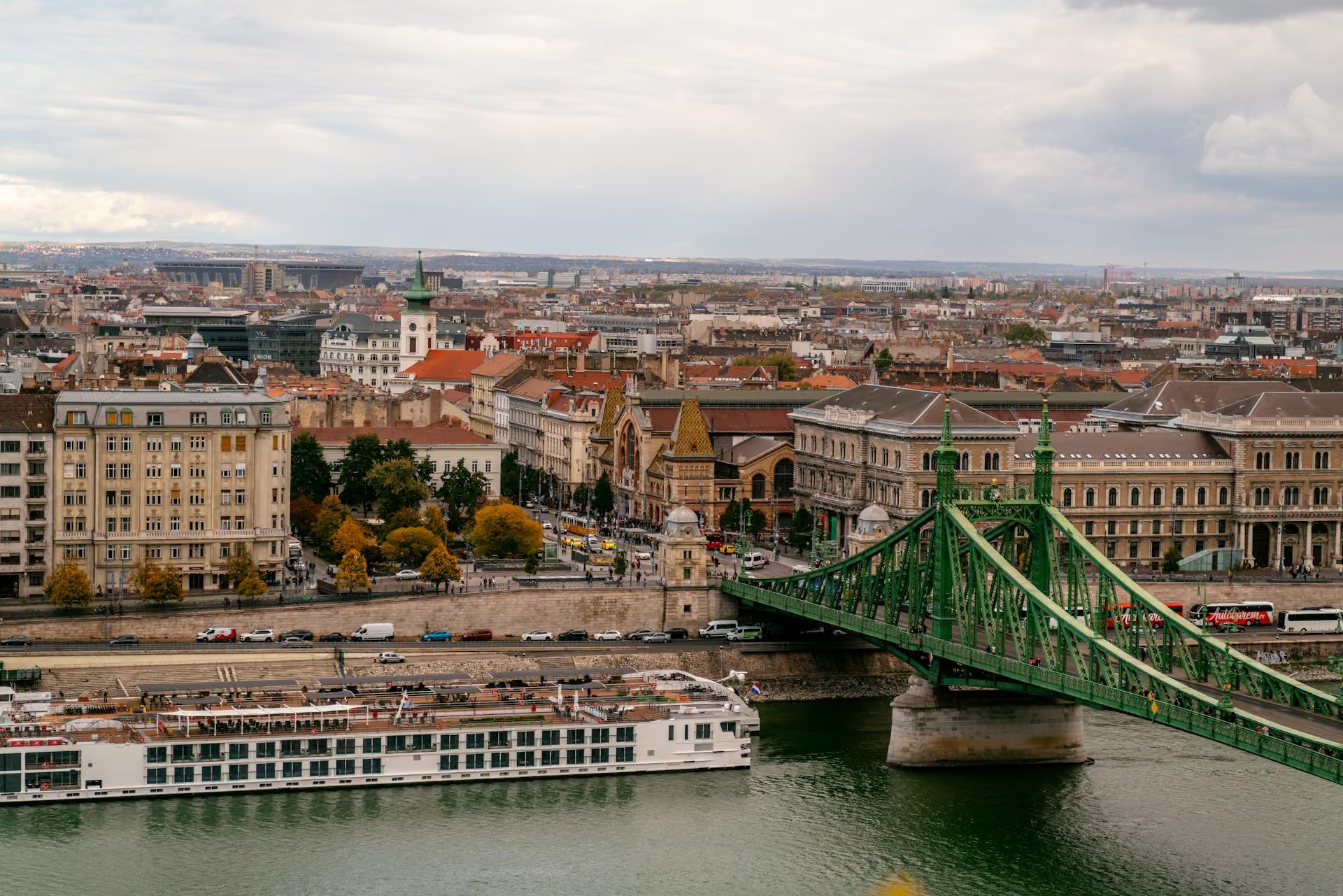
Budapest, Hungary
.svg)
This case innovation has been analysed using the Transformative Intervention Mixes (TIMs) framework. The framework maps the regulatory, economic, social‑behavioural, technological and material interventions at play, clarifying how these elements interact and what this configuration suggests about the innovation’s capacity to support transformative change.
The case analysis draws primarily on evidence synthesised from:
GreenFormation (2024), Institute for Political Ecology (n.d.), Kiss (2025) and Kiss & Fischer (2026),
Overview
Degrowth Doughnut
Budapest Degrowth Doughnut (BDD)
Urban sustainability planning; climate neutrality and biodiversity integration; participatory policy development
A city-scale adaptation of the degrowth doughnut model co-created through workshops and consultations led by Corvinus University of Budapest and GreenFormation, producing a localised indicator set and system map and embedding the model into Budapest’s Climate City Contract.
City-scale framework for Budapest developed in 2024, with ongoing refinement and interest from additional decision-making bodies by 2025; positioned for monitoring and wider strategy integration.
Practical: Develops a localised indicator framework, visualisation and system mapping to make trade-offs and synergies tangible for planning and monitoring.
Political: Formal incorporation into Budapest’s Climate Contract and structured dialogue between academia, municipality and sectoral actors shapes decision-making and institutional uptake.
Personal: Participatory workshops and facilitation support reflective learning culture, risk-taking and shared understanding among participants.
High: Next steps include updating indicators with new data, enhancing visual communication, widening participation, and linking indicators to practical tools and open-access guidance for sustained engagement.
TIMs Summary
The case evidences strong knowledge and technology tools through the development of indicator frameworks, system mapping and digital visualisations, combined with intensive voluntary–advisory–educational processes via participatory workshops and bilateral consultations. Political mechanisms are strongly evidenced through the formal municipal partnership and the incorporation of the methodology into Budapest's Climate Contract, which provides an institutional anchor for the uptake of the policy recommendations developed through the participatory workshops. Financial/ market-based tools are weakly evidenced in the documented process, with emphasis placed on co-creation, legitimacy and policy integration rather than incentives. Regulatory levers are discussed mainly as contextual issues (e.g., regulatory gaps in relation to behavioural change) rather than implemented tools within the case.
This configuration implies an epistemic–institutional pathway, where co-produced evidence, visualisation and formal policy embedding aim to shift planning practices and enable broader debate on trade-offs. Implementation is constrained by capacity and time limits for broad participation, fragmented municipal decision-making structures and weak public awareness of the BDD, as well as challenges in sourcing local data and balancing ecological and social priorities. At the same time, the case benefits from a strong civil-society base, existing participatory structures and emerging ecological greenspace practices that can act as leverage points for further embedding and scaling.
Implications for Intervention Mix Design
The indicator framework explicitly links ecological boundaries with social foundations such as affordable housing, access to mobility, health care, education and cultural life, reflecting workshop discussions that emphasised equality, redistribution and the ’catching up‘ of poorer groups. This analytical reflection suggests that enhancing this innovation’s transformative scope would require alignment with additional tool categories not currently prominent – particularly market-based or funding mechanisms to support long-term monitoring, facilitation and wider civic engagement, and clearer choice-architecture tools to translate indicators into low-barrier everyday actions. It also implies that broader institutional arrangements would be needed to mainstream the approach across additional city departments and stakeholders. The case does not evidence these additions as currently implemented but indicates them as future directions. Partial or purely techno-optimising uses of tools (for example, digital twins or isolated environmental upgrades) risk reinforcing existing growth-oriented or inequitable logics if not combined with fairness-oriented measures.
TIMs Matrix
| Tool Category | Examples | How it ENABLES (mechanisms) | How it HINDERS (barriers) | Opportunities to strengthen | Risks / caveats | Additional suggestions and resources |
|---|---|---|---|---|---|---|
| Regulatory | Discussion of regulatory gaps overriding individual intentions in sustainability transitions and of fragmented municipal strategies that hinder cross-sectoral, BDD-aligned planning. | Regulatory landscape frames constraints on behavioural change and highlights limits of relying on individual action alone. | Regulatory gaps and entrenched institutional practices are described as barriers that can override sustainability intentions. | Develop BDD-linked planning and budgeting requirements (e.g. integrating doughnut indicators into urban plans, greenspace standards and housing policies) and use pilot districts or policy labs to test regulatory packages that jointly address ecological limits and social equity. | If regulatory context remains misaligned, indicator frameworks may have limited leverage on practice. | Urban policy reform processes; indicator-linked urban planning requirements; sustainability performance standards for municipal projects; pilot districts or policy labs. |
| Financial / Market-Based | Market drivers such as aggressive pricing described as barriers; limited evidence of dedicated financing mechanisms to support BDD implementation, monitoring and participation. | Market-based barriers are described as capable of overriding individual intentions and complicating behavioural shifts. | Design robust resource mobilisation mechanisms at municipal and national level (including better use of EU funds and carefully framed private-sector involvement) to provide stable funding for indicator maintenance, civic engagement and BDD-aligned pilot projects. | Without sustained resourcing, monitoring and engagement may be difficult to maintain. Financing tools must avoid deepening inequalities or shifting transition costs disproportionately to lower-income groups. | Urban sustainability financing mechanisms (e.g., a Budapest Degrowth Transition Fund to support indicator development and follow up projects, small neighbourhood grants tied to local BDD indicator improvements, and multi-year funding lines for monitoring and participatory facilitation). | |
| Information / Education | Participatory workshops introducing the framework (and degrowth itself) and building consensus; dissemination beyond academia via public-facing materials and educational platforms. | Participatory analysis builds shared understanding across expert and policy audiences and supports learning about complex trade-offs through facilitated discussion and communication. | Limited time and resources constrain deeper engagement; technical complexity and accessibility for non-experts can create tension. Some diagnostic questions are subjective with results not immediately visible, which can reduce perceived transparency. Reluctance towards the concept of degrowth is still high. | Tailor outputs more carefully to non-expert audiences and widen engagement beyond the core group, as discussed. | If communication is not accessible, broader uptake may remain limited to expert circles. | Urban sustainability education programmes; civic engagement campaigns. |
| Choice Architecture | Use of accessible graphics and scenario modelling to clarify complexity; proposals for practical tools linked to indicators to translate goals into everyday behaviour. | Structures decision environments by making trade-offs salient and providing potential guidance pathways from indicators to action. | Practical tools linked to indicators are identified as needed but not yet realised in the documented case. | Develop low-barrier, indicator-linked tools and open-access guidance on municipal platforms helping residents compare everyday choices (e.g. food, mobility, leisure) and understand their impact on BDD indicators. | Poorly designed tools could oversimplify systemic limits or shift responsibility inappropriately to individuals. | Nudge-based urban programmes; indicator-linked behaviour tools. |
| Social Norms | Democratic workshop atmosphere and consensus-building; trust-building among academic, municipal and sectoral actors. | Reinforces collaborative norms and shared expectations of participation, supporting legitimacy and sustained partnership. | Scaling participation beyond the core group reveals differences in expectations and inclusion. If broader civil society is not consistently involved, norms of collaboration may remain limited to a small circle. | Create more inclusive strategies and opportunities for iterative engagement across sectors and departments building on existing civil society initiatives and participatory structures. | If perceived as expert-driven, the process may not generate broader civic ownership. | Participatory governance models; community of practice networks. |
| Emotional Appeal | Motivational impact of accessible infographics, animations for decision-makers and the public; celebration of milestones such as formal adoption. | Positive reinforcement and perceived proof of impact can sustain engagement and institutional confidence. | Crises around data and indicators can create frustration if not well facilitated. | If enthusiasm outpaces capacity, expectations may be unmet. | Public storytelling for urban transitions. | |
| Technology | Digital scenario visualisation; real-time digital modelling; production of a system map and visualised doughnut framework. | Supports problem-solving and integration of complex data, enabling shared interpretation of trade-offs and synergies. | Technical barriers in sourcing local data and integrating context-sensitive indicators slow development. | Update the model with new data and maintain transparent monitoring and open-access guidance, as proposed. | If data quality is weak, outputs may be contested or lose credibility. | Urban systems modelling tools; open-data monitoring platforms. |
| Infrastructure (Hard/Soft) | Structured facilitation and professional organisation; formal partnership with Budapest Municipality; validation workshop and feedback loops. | Provides coordination and process infrastructure that sustains participation, manages consensus and conflict, and supports institutional embedding. | Municipal capacity constraints initially slowed engagement; limited workshop time restricted some participation. | Widen participation to more city departments and civic stakeholders and maintain continuous feedback structures. | Over-reliance on a small core group may limit resilience and diffusion. | Urban transition labs; structured facilitation models. |
| Biophysical Resources | Indicator set includes green areas, biodiversity loss and nature connectivity; proposals for habitats, green corridors and pollinator pathways included in next steps | Frames urban ecological functions as measurable components of the city's transition planning. | Biophysical improvements depend on implementation beyond modelling and indicator development. | Integrate biodiversity-related indicators with concrete urban nature pilot activities as discussed. | If implementation lags, indicators may not translate into ecological outcomes. | Green corridor planning; pollinator pathway initiatives. |
| Knowledge | Localised indicator development and consensus-building; workshop-produced narrative and policy outputs; research dissemination and academic-policy bridge. | Participatory approach and localised indicators create a shared analytical frame and legitimises new approaches within municipal policy documents and planning debates. | Difficulties in data sourcing and balancing priorities create tensions over technical rigour and accessibility. | Assess impacts beyond CO2 through indicators such as access to environmental goods and biodiversity metrics, as described. | Misinterpretation of indicators without context can distort priorities. | Indicator-based planning frameworks; science-policy interfaces. |
| Other |
Note: Blank cells reflect that the documentary evidence available for this case did not contain sufficiently explicit information to address these dimensions. This absence should not be interpreted as implying that such mechanisms were irrelevant or ineffective, but simply that they were not documented within the scope of the source materials.