


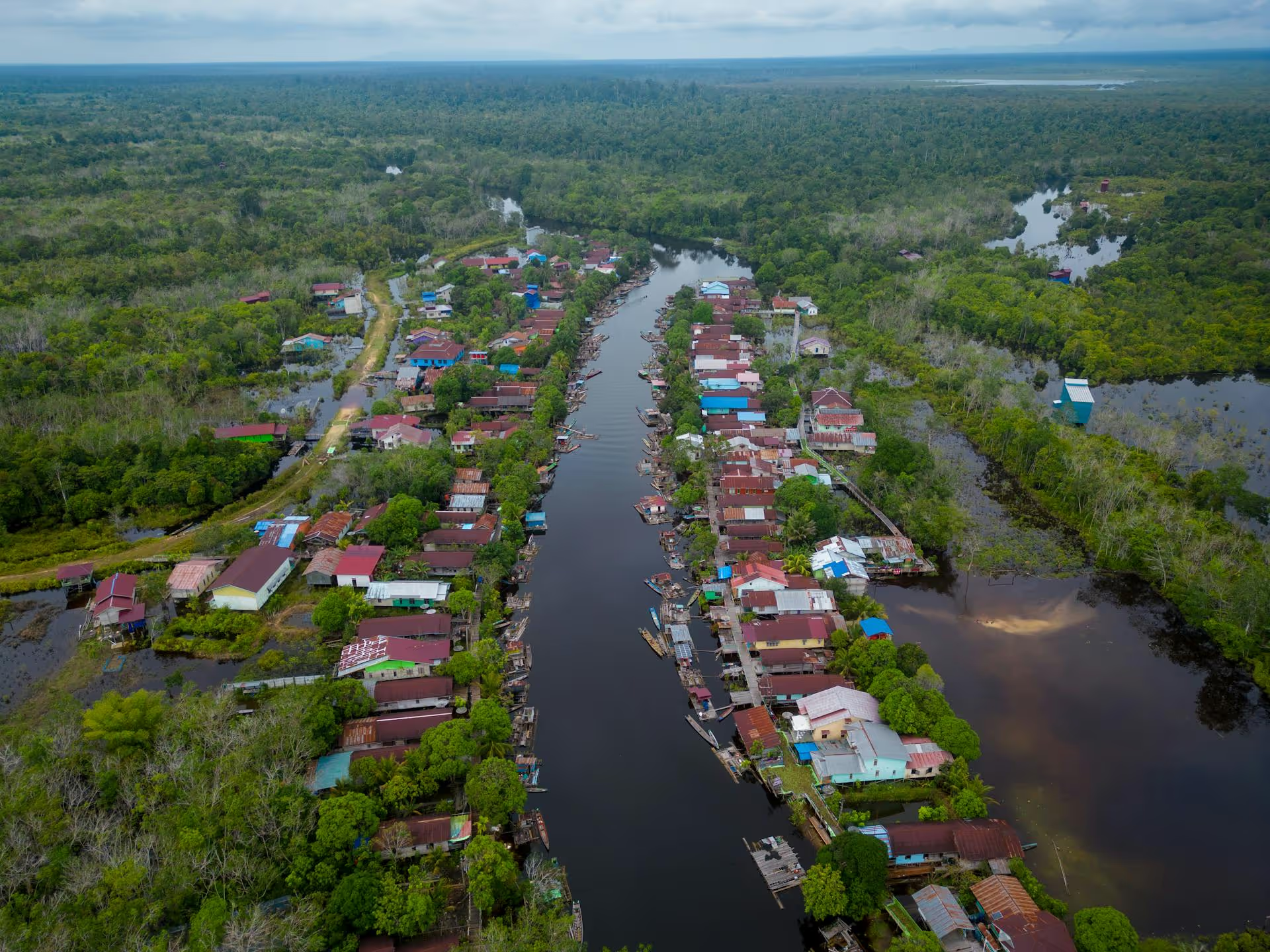
Income for People Living in Biodiversity-rich Conservation Areas
.svg)
This case innovation has been analysed using the Transformative Intervention Mixes (TIMs) framework. The framework maps the regulatory, economic, social‑behavioural, technological and material interventions at play, clarifying how these elements interact and what this configuration suggests about the innovation’s capacity to support transformative change.
The case analysis draws primarily on evidence synthesised from:
Fletcher & Büscher (2020)
Overview
Conservation Basic Income (CBI)
Conceptual proposal for an unconditional basic income paid to people living in and around biodiversity-rich conservation areas to support livelihoods and reduce pressures driving environmental harm.
Conservation finance, livelihoods, and social policy linked to biodiversity protection
The proposal is conceptual only within the source material (rather than being an implemented programme)); it is framed as addressing limitations of market-based conservation and seeking socially just conservation aligned with ‘convivial’ approaches.
Conceptual/global proposal intended for application across conservation-relevant geographies.
Practical: The (conceptual) proposal aims to support livelihoods in conservation-critical areas so recipients can reduce dependence on destructive extraction and sustain conservation-compatible practices.
Political: It advances redistribution, taxation, and alternative governance arrangements as part of a shift beyond market-based conservation.
Personal: The source material emphasises dignity, autonomy, non-withdrawable support, and the possibility of less instrumental relations with nature for historically dispossessed communities.
The proposal is designed as a scalable policy concept, drawing on the generalisable structure of basic income applied to conservation contexts.
TIMs Summary
This case - a conceptual proposal - is strongly evidenced in Financial/ Market-Based mechanisms, proposing unconditional cash transfers as a core instrument to reshape economic conditions around conservation. Knowledge tools are present through conceptual critique of existing conservation approaches and articulation of a policy design rationale, but empirical programme evidence is not provided in the source material. Regulatory tools are discussed in relation to how conservation and redistribution could be governed, but binding instruments are not specified as implemented mechanisms. Voluntary-advisory-educational, Technology, and Choice architecture tools are not central to the proposal.
The configuration implies a distributive pathway: transformation is pursued through reallocating resources and reducing structural livelihood pressures rather than through persuasion or technological change. Implementation-wise, the proposal foregrounds equity and social justice as design premises, implying that targeting, governance and accountability would be decisive for outcomes.
Implications for Intervention Mix Design
As a proposal, the Conservation Basic Income (CBI) would require alignment with complementary governance instruments (e.g., eligibility rules, payment administration, and accountability mechanisms) to operationalise it; these are not detailed as implemented tools in the source material. Where biodiversity outcomes are sought, additional alignment may be needed with biophysical stewardship arrangements and monitoring systems to understand effects, without assuming conditionality.
TIMs Matrix
| Tool Category | Examples | How it ENABLES (mechanisms) | How it HINDERS (barriers) | Opportunities to strengthen | Risks / caveats | Additional suggestions and resources |
|---|---|---|---|---|---|---|
| Regulatory | Proposed funding through increased state taxation or a carbon tax; discussion of residency criteria and eligibility rules for recipients in conservation-critical areas. | The legal and rule-based components of the proposed CBI would define who is included, how resources are raised, and how a CBI could be administered. | The regulatory features remain unresolved design questions rather than settled institutional arrangements. | Further research on community definition, payment levels, migration effects, and wider political discussion are needed before implementation. | Poorly designed eligibility or financing rules could weaken legitimacy or reproduce exclusion. | Revenues contributing to income support; monitoring social and ecological outcomes; public reporting of programme funding and beneficiaries; eligibility and territorial designation rules. |
| Financial / Market-Based | Unconditional basic income payments to people in and around conservation areas. | The initiative, as conceptualised, alters economic constraints by providing predictable income support; it is intended to reduce pressure to engage in environmentally harmful activities and support conservation-compatible livelihoods. | There are unresolved questions about payment levels, funding sources, and whether cash transfers could unintentionally increase resource use or attract in-migration. | Combining redirected conservation finance with taxation, grants, donor support and other revenue streams. | Risks discussed in the source material include potential unintended social and ecological effects depending on design and context. | Unconditional cash transfers to people in and around conservation areas; progressive conservation taxes earmarked for these payments; ecological fiscal transfers rewarding jurisdictions hosting protected areas; community trust or solidarity funds pooling public, conservation and philanthropic revenues; and complementary stewardship payments where appropriate, without making income strictly conditional on measured biodiversity outcomes. |
| Information / Education | Community engagement and environmental education are suggested in the source material as complementary supports. | The proposed educational- and engagement-supporting processes could help channel payments toward conservation-compatible practices and broader community understanding. | The source material treats the educational and engagement dimensions as supplementary rather than core mechanisms, and does not provide an implementation model. | Pairing income support with locally appropriate engagement and learning processes. | Educational support may be ineffective if it substitutes for, rather than complements, reliable income and services. | Environmental education; community engagement; ethics-based conservation support. |
| Choice Architecture | Discussion (within source material) of labelled cash transfers and rhetorical framing of payments; contrast between conditional and unconditional transfer design. | Framing transfers in ways that signal conservation purpose can shape behaviour without imposing formal conditionality. | . | Payment design and framing warrant further testing in future pilots. | Subtle framing tools may be too weak to address complex livelihood and conservation pressures on their own. | Labelled cash transfers; unconditional transfer design; nudge-based programme framing. |
| Social Norms | ||||||
| Emotional Appeal | ||||||
| Technology | GIS mapping is suggested, in support of operationalising the proposed CBI initiative, to identify communities important to biodiversity hotspots and target recipients. | The proposed GIS mapping component supports spatial targeting of payments in conservation-critical areas. | The GIS mapping is proposed in the source material as a complementary administrative tool. | Improved targeting and monitoring capacity if pilot programmes are developed. | Technical targeting may exclude people or places if the mapping criteria are poorly specified. | |
| Infrastructure (Hard/Soft) | Possible partnerships with the Indigenous and Community Conserved Areas (ICCA) consortium; coalitions of state and non-state actors to deliver income and social services where states are weak; broader convivial conservation framework. | The proposed organisational arrangements provide the governance infrastructure through which CBI could operate in different settings. | Many conservation-critical areas lack strong states and reliable services, making delivery difficult. | Combining income support with service provision and broader coalitions suited to local institutional capacity. | If support infrastructure is weak, cash payments alone may not deliver intended conservation or wellbeing outcomes. | ICCA-linked delivery; coalition-based service provision; convivial conservation governance. |
| Biophysical Resources | ||||||
| Knowledge | Conceptual framing linking basic income to ‘convivial conservation’ and critique of prevailing conservation approaches. | The CBI, as proposed in the source material, provides an analytical rationale for rethinking conservation–livelihood relations via redistribution rather than marketisation. | The proposal is conceptual only within the source material. | Research on recipient definition, conditionality, payment level, medium of payment, migration and resource-use effects. | Conceptual proposals may be interpreted as universally applicable despite context dependence. | Nature-Based Thinking (see Complementary TIMs links above) as an analytical approach to governance/community/nature relations. |
| Other | Convivial conservation as the broader paradigm within which CBI is situated. | The hybrid framing of the proposed CBI links redistribution, justice, and post-market conservation into a wider shift in biodiversity policy and practice. | The source material acknowledges that CBI alone is not a silver bullet and must sit within wider structural change. | An explicit strengthening opportunity included in the source material is to treat CBI as part of a broader transition rather than as a stand-alone instrument. | There is a risk of overestimating what income support can achieve if wider political-economic drivers of biodiversity loss remain unaddressed. | Convivial conservation; redistribution-based conservation; post-market conservation finance. |
Note: Blank cells reflect that the documentary evidence available for this case did not contain sufficiently explicit information to address these dimensions. This absence should not be interpreted as implying that such mechanisms were irrelevant or ineffective, but simply that they were not documented within the scope of the source materials.